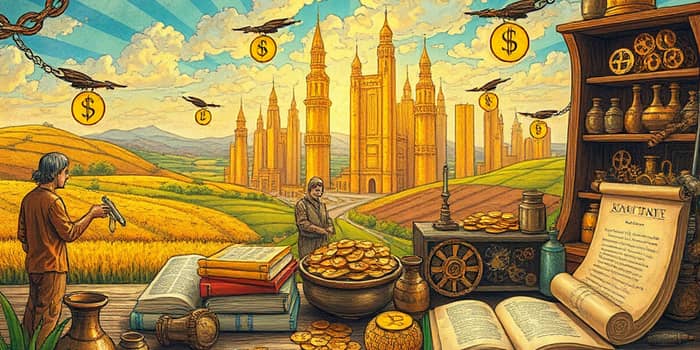
Across centuries, the quest to turn humble materials into enduring wealth has evolved from mystical pursuits to concrete economic strategies. Today’s innovators, policymakers, and entrepreneurs continue the age-old tradition of human ingenuity transforming ordinary resources into wealth, crafting prosperity where none existed before.
The Legacy of Alchemy in Money Creation
In 17th-century England, as commerce boomed, scholars sought a practical elixir to expand gold and silver supplies. Early alchemists aimed to transmute base metals into precious ones, driven by the hope of limitless riches.
When literal alchemy failed, thinkers embraced metaphorical alchemy: creating money based on credit. Banks that inspired trust were hailed as the nation’s philosopher’s stone, able to “multiply the stock of the Nation…in Infinitum.” This leap—shifting from metal coins to credit-based currency—laid the foundation for the modern economy, allowing money supply to grow in step with trade.
Modern Alchemy: Human Ingenuity and Resources
Industrialization and scientific advances have repeatedly demonstrated that prosperity arises from better methods, not just raw abundance. In Abraham Lincoln’s era, roughly 90% of Americans worked the land. Today, only about 2% do, yet food production per person has soared.
These achievements showcase production beats consumption for prosperity: by improving fertilizers, machinery, and techniques, societies have human ingenuity transforming ordinary resources into wealth on an astonishing scale. It is this creative spark—this modern alchemy—that underpins rising living standards worldwide.
The Philosopher’s Stone: Institutions and Policies
Abundant resources alone do not guarantee wealth. Countries rich in minerals or hydroelectric potential often lag behind those with fewer endowments. The real catalyst is institutions, norms, and policies that align incentives, protect property, and foster openness.
- Effective institutions
- Open economies
- Empowered, educated citizens
Reforms in China, India, and Eastern Europe after the early 1990s illustrate this truth. By integrating into global markets and strengthening domestic governance, these regions lifted nearly a billion people out of extreme poverty—underscoring the philosopher’s stone of institutions and governance.
Production versus Consumption Alchemy
Development efforts often measure success by boosting consumption—raising incomes just above poverty lines. Yet true, lasting change comes from expanding productive capacity. The Stanford Social Innovation Review argues that we must shift our focus to job creation, firm growth, and technological adoption.
Philanthropy and policy should support the “doers” who build industries, transfer skills, and foster entrepreneurship. For example, secondments from global manufacturers to local firms can accelerate managerial know-how, turning factories into engines of sustainable growth.
Factors of Production: The Alchemical Ingredients
Classical economics identifies four essential elements: land, labor, capital, and entrepreneurship. Prosperity emerges when a society combines these inputs with knowledge and vision. Viewing them as ingredients in a recipe highlights their interdependence:
When these elements interact under supportive policies and social norms, they form the crucible of growth, turning basic inputs into high-value outputs.
Knowledge: The Ultimate Catalyst
Economist Paul Zane Pilzer famously argued that physical resources are effectively infinite once we discover how to use them. In this view, knowledge as the ultimate resource powers ongoing transformation, unlocking new applications and efficiencies.
Every technological breakthrough—from synthetic fertilizers to renewable energy—reinforces the idea that intellectual advances can create wealth far beyond the sum of raw materials.
Real-World Transmutations: Cases of Economic Alchemy
Several landmark examples illustrate how economic alchemists reinvent industries:
- Agricultural transformation: Mechanization and improved seeds raised yields with fewer workers.
- Transportation revolution: From horse-drawn carriages to electric vehicles, innovation has reshaped mobility.
- Business model innovation: Companies like Netflix have evolved to capture new markets through adaptive strategies.
Each case underscores the power of innovation to reimagine sectors and generate prosperity.
Conclusion: Embracing the Alchemy of Tomorrow
The journey from turning lead into gold mirrors our modern challenge: converting land, labor, capital, and ideas into widespread well-being. By blending robust institutions, bold entrepreneurship, and unceasing curiosity, societies become true economic alchemists, capable of forging prosperity from the most ordinary elements.
As we confront global challenges—climate change, inequality, resource constraints—the next wave of alchemical breakthroughs will come from those who harness knowledge, foster inclusive policies, and empower individuals. In that endeavor lies our greatest opportunity to transform the world’s resources into lasting wealth for all.
References
- https://bigthink.com/articles/how-alchemy-led-to-the-modern-economy/
- https://cepr.org/voxeu/columns/prosperity-countries
- https://www.heritageconsultants.com/economic-alchemy/
- https://ssir.org/articles/entry/when_it_comes_to_promoting_prosperity_production_beats_consumption
- https://steadystate.org/capital-debt-and-alchemy/
- https://www.prosperity.com/media-publications/how-nations-succeed-analyses-of-national-transformation/
- https://hub.papersowl.com/examples/the-alchemy-of-economics-factors-of-production-in-a-fantasy-world/
- https://www.visionofhumanity.org/five-charts-on-economic-prosperity-peace-and-business/
- https://www.workers.org/2007/editorials/economy-0927/
- https://www.un.org/en/climatechange/17-goals-to-transform-our-world
- http://paulzanepilzer.com/uwsoundviewp1-htm
- https://www.youtube.com/watch?v=mKVl2FczdxY
- https://www.minneapolisfed.org/article/1998/sources-of-prosperity