We live on a planet teeming with life but bound by physical limits. Modern civilization has expanded to every continent, exploiting mountains of ore, drilling deep into fossil reservoirs, and drawing water from underground aquifers. Yet this impressive growth comes with a stark reality: we inhabit a world of finite resources that exist in limited quantities. The specter of scarcity looms as we consume at speeds that outpace natural regeneration, pushing ecosystems beyond the breaking point.
Despite astonishing advances in science, technology, and industry, humanity now finds itself running a full Earth economy. No longer can we assume an open frontier ripe for endless extraction. Our challenge is twofold, physical and social: how to respect natural boundaries while ensuring equitable access and wise governance of the resources we depend on.
The Anatomy of Scarcity
Scarcity arises when the demand for a resource exceeds its availability or regenerative capacity. In ecological terms, humanity’s demand on nature exceeds Earth’s biocapacity, a state known as ecological overshoot. This condition persists because consumption has grown without corresponding improvements in efficiency or reductions in waste. Fossil fuels, many mineral ores, and freshwater supplies face depletion if current trajectories continue.
Yet scarcity is not solely a matter of physical stock. Governance plays an equal role in how resources are allocated, protected, and transformed into goods and services. Economic structures, power dynamics, and legal frameworks shape whether communities can access clean water, fertile land, or steady energy.
- Physical scarcity: finite stock or limited regenerative capacity of key resources.
- Governance scarcity: policies and institutions that manage allocation and use.
Global Trends Shaping Our Future
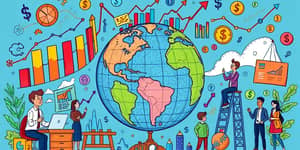
Over the past half-century, global material consumption has more than tripled, rising at an average of 2.3% per year. The UN projects that by 2060, consumption could jump by another 60% compared to 2020 levels. Meanwhile, humanity’s footprint outstrips the planet’s ability to renew itself by a factor of 1.7 annually. More than 80% of the global population lives in countries operating in an ecological deficit, relying on resource imports or depleting their own natural capital.
Inequality in resource use deepens the challenge. High-income nations consume six times more materials per capita and generate ten times more climate impacts compared to low-income countries. Meanwhile, the poorest billion people subsist on less than 2% of global resources. Any path toward sustainability must address these disparities as much as it does absolute limits.
Case Study: Water Scarcity at the Frontline
Water is the most immediate expression of resource scarcity. A quarter of the world’s population already lives under extremely high water stress, using 80% or more of available freshwater annually. By 2050, another billion people will face severe shortages driven by population growth, declining groundwater levels, and climate change. Droughts are lengthening, and rainfall patterns are shifting unpredictably, pushing traditional water systems to the brink.
In cities like Cape Town and Rome, the threat of “Day Zero” – when taps run dry – has sparked innovative responses. Across the globe, communities are adopting mixed strategies that marry technology, policy, and conservation to safeguard supplies.
- Demand management and efficiency: smart metering, tiered pricing, leak reduction.
- Innovative water sources: large-scale reuse, desalination, rainwater harvesting.
- Adaptive governance: inter-basin transfers, regional planning, accountable utilities.
Land, Biodiversity, and Food Security
Agriculture occupies nearly half of all habitable land, driving deforestation, soil erosion, and biodiversity loss. Soil degrades faster than it forms, and millions suffer under desertification exacerbated by over-plowing and over-grazing. Ecosystems that purify water, regulate climate, and pollinate crops are under siege.
Deforestation removes roughly 10 million hectares of forest each year, an area equivalent to the size of South Korea. Major drivers include cattle ranching, oilseed cultivation, and subsistence agriculture. Ensuring food security and conserving biodiversity demands a delicate balance between productivity and preservation, anchored in distributive justice in resource management.
- Cattle grazing (≈41% tropical deforestation)
- Oilseed expansion (≈18%)
- Subsistence farming (up to 84% in some regions)
Energy and the Path to Renewables
Fossil fuels have powered the modern era but at grave cost: greenhouse gas emissions, air pollution, and now looming supply constraints. Peak oil and gas debates highlight the risks of dependence on finite fuels. Meanwhile, renewable sources like solar and wind present scalable alternatives yet face challenges in intermittency, storage, and infrastructure integration.
Moreover, energy and water systems are deeply intertwined. Thermoelectric power plants require substantial water for cooling, while pumped storage and biofuel production strain freshwater supplies. In this complex nexus, decoupling human well-being from material throughput necessitates innovations that span efficiency, smart grids, and cross-sector coordination.
Towards Sustainable Resource Management
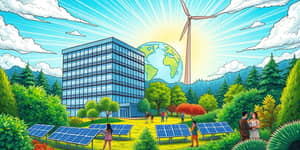
Solving scarcity’s challenge calls for holistic strategies that honor planetary boundaries while promoting human development. Technological breakthroughs—for example, advanced recycling, precision agriculture, and circular design—must be matched with strong governance frameworks that incentivize conservation and penalize waste.
Embracing sustainable circular economy principles means viewing waste as a resource, designing products for reuse, and extending lifecycles. Incentive structures like carbon pricing, resource taxes, and tradable permits can shift both corporate behavior and consumer choices toward long-term stewardship.
Ultimately, a resilient future requires collective action. Citizens, businesses, and governments must align around shared goals, crafting policies that integrate social equity with ecological health. Engaging communities in decision-making ensures diverse voices shape the rules that govern their water, land, and energy.
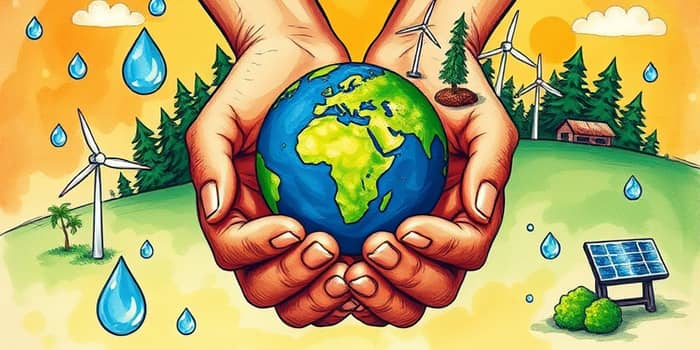
At the heart of this transformation lies a simple truth: prosperity and planetary health are inseparable. By harmonizing human ambition with planetary boundaries, we can build societies that flourish within Earth’s finite limits. This is scarcity’s challenge—and our greatest opportunity to redefine growth, justice, and sustainability for generations to come.
References
- https://www.worldbank.org/en/news/feature/2018/04/05/how-can-water-scarce-cities-thrive-in-a-resource-finite-world-new-world-bank-report-shares-strategies-and-solutions
- https://www.weforum.org/stories/2024/03/sustainable-resource-consumption-urgent-un/
- https://www.unsdglearn.org/courses/water-scarce-cities-thriving-in-a-finite-world/
- https://populationconnection.org/why-population/natural-resources/
- https://math.answers.com/math-and-arithmetic/How_can_you_manage_finite_resources
- https://monthlyreview.org/articles/global-resource-depletion/
- https://www.ebsco.com/research-starters/environmental-sciences/resource-depletion
- https://thrivabilitymatters.org/thrive-framework/thrive-framework-finite-resources/
- https://en.wikipedia.org/wiki/Resource_depletion
- https://ideas.repec.org/a/eee/inecon/v136y2022ics0022199622000241.html