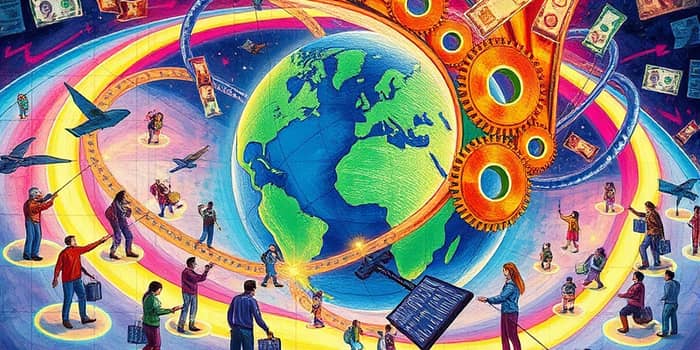
The concept of value velocity captures the essence of how money moves through an economy, igniting growth and shaping prosperity. By exploring its foundations, critiques, historical trends, and actionable strategies, this article offers a comprehensive guide to accelerating economic flow and sustainable growth while addressing modern challenges and global imperatives.
Understanding the Core Concept
At its simplest, velocity of money measures the rate at which currency circulates within a given period. It quantifies how often one unit of money finances transactions for goods and services. When velocity is high, each dollar supports more economic activity; when it slows, growth can falter.
The foundational equation of exchange brings clarity to this relationship:
M × V = P × T
where M is the money supply, V is velocity, P is the price level, and T represents transaction volume or real output. In macroeconomic analysis, a common variant simplifies this to M × V = GDP, tying money stock and velocity directly to overall economic output.
Concrete Examples Illuminate Value
Understanding abstract equations becomes easier through real-world examples. Consider:
- A $10 bill circulating with velocity of 3 finances $30 in annual transactions.
- A $500 billion money supply with velocity of 6 underpins $3 trillion in trade.
- An economy with $50 in currency and $100 GDP yields a velocity of 2, as each dollar changes hands twice.
Each example shows how greater turnover amplifies the economic impact of a fixed money stock, fueling employment, production, and services across sectors.
Critiques and Real-World Nuances
Despite its elegance, value velocity faces important critiques. The most salient is that money itself does not produce real goods or services—real output comes from labor and capital. In a barter analogy, a baker selling bread for tomatoes uses actual goods to secure potatoes, not the money itself.
Other limitations include the model’s insensitivity to wealth distribution and its tendency to overlook precautionary savings or hoarding during downturns. In recessions, consumers and firms may sit on cash, driving velocity down even if the central bank injects liquidity.
Patterns, Data, and Recent Trends
Historical data reveal how value velocity shifts with economic cycles. In February 2020, the U.S. witnessed an 80% annual surge in an "Austrian" measure of money supply growth, laying groundwork for potential price pressures. Meanwhile, FRED’s M2 velocity time series highlights a long-term downward trend over recent decades, reflecting both demographic shifts and changes in saving behavior.
Below is a snapshot of key metrics that illustrate these trends:
Behavioral Drivers of Velocity
Consumer and business confidence play pivotal roles in shaping velocity. During expansionary phases, optimism fuels spending and investment, setting off a virtuous cycle of hiring and production. Conversely, fear of job loss or uncertain markets prompts saving, causing velocity to slump.
This behavioral lens underscores that monetary policy alone cannot guarantee high velocity; psychological factors and structural conditions must align to sustain vigorous economic flows.
Strategies to Accelerate Economic Flow
Policymakers and business leaders aiming to boost value velocity must adopt multifaceted approaches. Investment stands at the forefront, expanding capacity and creating new opportunities for exchange.
- Deploy the right capital and infrastructure: Investing 2–3% of GDP annually—primarily via private channels—can deliver modern, low-carbon energy systems and transport networks.
- Foster innovation and systems transformation: Public support for emerging technologies, regulation that encourages digitalization, and institutions that coordinate change in industry and cities.
- Implement smart policy frameworks: Carbon pricing, urban redesign, and incentives for sustainable practices can simultaneously enhance productivity and reduce environmental impact.
- Mobilize diverse financing channels: International cooperation, voluntary carbon markets, and targeted public investments can catalyze private capital in emerging economies.
Balancing consumer and investor roles is equally crucial. Restoring equilibrium—by increasing household spending power while ensuring attractive returns for investors—helps maintain momentum without sowing inflationary pressures reminiscent of the high-inflation 1970s.
Global Imperatives and Sustainable Growth
The United Nations Sustainable Development Goal 8 calls for sustained per capita economic growth, especially aiming for ≥7% annual GDP growth in least developed countries. Achieving this demands:
- Diversification of economies into high-value, labor-intensive sectors.
- Formalization of informal labor markets with protections for women and youth.
- Innovation-driven productivity improvements with equitable access.
- Policies that decouple growth from environmental degradation.
By weaving inclusive and sustainable practices into the acceleration of value velocity, nations can foster prosperity without compromising ecological integrity or social equity.
Conclusion
Value velocity stands as both a barometer and an engine of economic vigor. Tracking the frequency of money’s circulation reveals underlying confidence, inflationary risks, and growth potential. To accelerate this financial dance, stakeholders must invest wisely, craft forward-looking policies, and champion innovation while safeguarding social and environmental goals.
As economies navigate the challenges of digital transformation, climate imperatives, and global competition, accelerating value velocity offers a powerful lever to maximize prosperity. By understanding its mechanics and deploy
ing targeted strategies, we can ensure that every dollar turns more frequently, fueling a more dynamic, inclusive, and resilient global economy.
References
- https://mises.org/mises-wire/understanding-money-velocity-and-prices
- https://www.weforum.org/stories/2022/07/sustainable-resilient-inclusive-economic-growth/
- https://chain.link/article/velocity-of-money
- https://necsi.edu/accelerating-economic-growth-and-opportunity
- https://en.wikipedia.org/wiki/Velocity_of_money
- https://www.un.org/sustainabledevelopment/economic-growth/
- https://www.genesiswealthplanning.com/blog/the-fascinating-dance-of-the-velocity-of-money
- https://www.worldbank.org/en/research/publication/accelerating-investment
- https://fred.stlouisfed.org/series/M2V
- https://www.mckinsey.com/capabilities/strategy-and-corporate-finance/our-insights/six-strategies-for-growth-outperformance
- https://www.khanacademy.org/economics-finance-domain/ap-macroeconomics/ap-long-run-consequences-of-stabilization-policies/money-growth-and-inflation/a/money-growth-and-inflation
- https://www.brookings.edu/articles/four-ways-to-speed-up-productivity-growth/
- https://breakthrough3x.com/uncategorized/accelerate-business-growth-8-proven-strategies-for-success/
- https://www.youtube.com/watch?v=t1AmsLagFvg