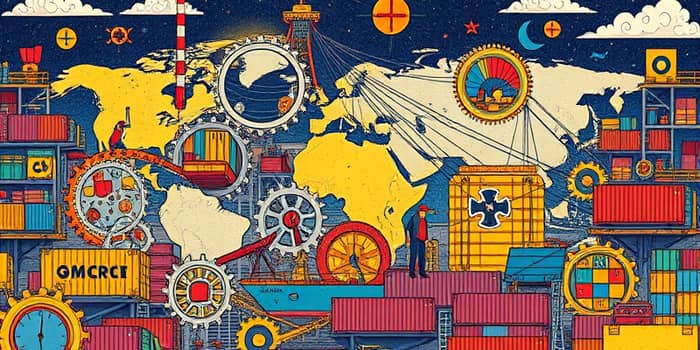
In the wake of recent crises, the intricate web of production and supply has never been more visible. From factory floors to policy debates, understanding how goods are made and delivered reveals the true engine of economic growth.
The Pandemic Moment: Supply Chains Laid Bare
When the pandemic struck in 2020, consumers faced shortages of essential products in every aisle. Masks, semiconductors, and shipping containers vanished from view, exposing just how complex global supply chains are.
Empty supermarket shelves and delayed deliveries sparked public curiosity: how could everyday items disappear overnight? The answer lay in the layered machinery that transforms raw materials into finished goods.
Inside the Production Function: Firms at Work
At the micro level, output (Y) emerges from combining capital (K), labor (L), and materials (M) in firms. Economists model this relationship as Y = F(K, L, M), but the real story occurs on factory floors.
Factories rely on:
- Specialized machinery and equipment that cannot be scaled instantly.
- Skilled labor and technicians with specific expertise.
- Intermediate inputs—components, energy, and raw materials.
When demand surges, firms cannot simply "turn on" more production. Capital intensity varies across sectors: semiconductor fabs demand billions in equipment, while retail outlets require minimal machinery. This disparity shapes the supply-side responsiveness of firms.
Supply Elasticity and Short-Run Bottlenecks
Supply elasticity measures how output responds to price or incentive changes. During 2020–22, factories faced fixed inputs and rigid constraints: plants and machines remained at full tilt, skilled workers were scarce, and logistics networks strained under unprecedented pressure.
Supply-Side Economics: Theory and Practice
Emerging in the 1970s amid stagflation, supply-side economics shifted focus from demand management to the forces that drive production and incentives. It argues that growth depends primarily on enhancing the capacity and motivation to produce.
Core Principles and Policy Pillars
Supply-side theorists emphasize after-tax returns as the key drivers of behavior:
- Labor supply rises with higher take-home wages.
- Saving increases when after-tax returns on capital improve.
- Investment accelerates via lower corporate and capital gains taxes.
Key policy instruments include:
Origins and the Laffer Curve
Arthur Laffer’s famous curve argued that cutting rates at very high levels could raise revenue by boosting reported income. This idea, popularized in the early 1980s, became a cornerstone of Reagan-era tax reforms.
Proponents claimed that steep tax cuts and deregulation would unleash unprecedented growth, shifting both short-run and long-run aggregate supply curves to the right.
Macro Realities: Global Chains in Crisis
Theory met reality when global shocks struck. COVID-19 lockdowns halted factories, while container shortages and port backlogs snarled shipments. The invasion of Ukraine further disrupted energy and commodity flows.
These crises revealed that supply chains are not infinitely elastic. Specialized equipment and skilled labor take time to deploy, and geopolitical instability can sever links overnight.
Triumphant Expansion vs. Fiscal Hangover
Supporters of supply-side policies highlight data from 1981–2005: U.S. real GDP grew 3.4% annually, with household net wealth tripling. They view the Reagan and subsequent expansions as proof that incentives matter.
Critics argue that growth rates in the 1980s barely outpaced the late 1970s once inflation is accounted for. They point to ballooning deficits and rising debt, noting that spending cuts never matched revenue losses.
Competing Narratives: Supply vs Demand
- Supply-Side View: Emphasizes production capacity and incentives as the engine of growth.
- Demand-Side View: Argues that recessions stem from insufficient demand and idle resources.
In practice, most economies blend both approaches: stimulating demand during downturns while seeking to improve long-run supply through investments and reforms.
Towards a More Resilient Future
The upheavals of recent years have taught us that visibility into the machinery of production is essential. Firms must build flexibility into their operations, diversifying suppliers and investing in adaptable technologies.
Policymakers, too, should balance short-term stimulus with measures that enhance resilience: strategic stockpiles, infrastructure upgrades, and incentives for rapid capacity expansion when shocks occur.
Conclusion: Illuminating the Unseen
By tracing the path from raw materials to final goods, we gain insight into both the promise and the peril of global production. Supply-side economics offers tools to foster long-term growth, but real-world crises remind us of the limits imposed by finite resources and complex networks.
Understanding the unseen machinery of production is not just an academic exercise—it is a guide for building an economy that can respond, recover, and thrive in an uncertain world.
References
- https://www.forcesofproduction.com/p/slow-slide-on-the-supply-side
- https://courses.lumenlearning.com/suny-oldwestbury-publicfinanceandpublicpolicy/chapter/supply-side-economics/
- https://99percentinvisible.org/episode/601-how-the-world-ran-out-of-everything/transcript/
- https://www.intelligenteconomist.com/supply-side-economics/
- https://econbrowser.com/archives/2011/04/implied_supply
- https://laffercenter.org/about/economics/
- https://www.youtube.com/watch?v=r2iKpTvDrzQ
- https://www.indeed.com/career-advice/career-development/supply-side-vs-demand-side
- https://la.utexas.edu/users/hcleaver/304L/304Lsupplyside.html
- https://www.andrew.cmu.edu/course/88-301/classical_model/who_supply.html
- https://www.econlib.org/library/Enc/SupplySideEconomics.html