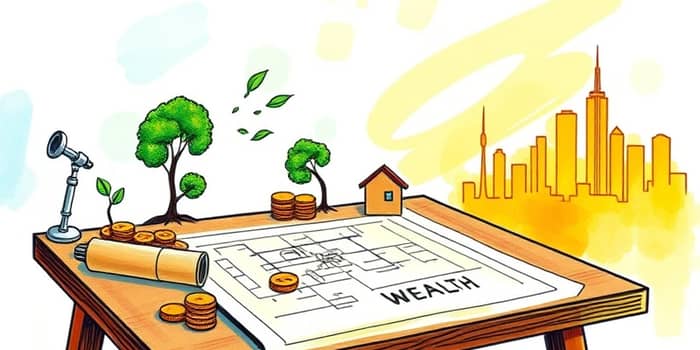
Every remarkable structure begins with a clear plan. In the same way, your financial journey flourishes when you take on the role of an investment architect, crafting a visionary roadmap before laying any bricks of action.
Embracing the Architect Mindset
Before you pour your first dollar into the market, imagine yourself standing over a large blueprint spread across a drafting table. This is more than a wishful sketch—it is your personalized guide, detailing every beam and column that supports your financial future.
- Blueprint = your comprehensive financial plan
- Foundation = budgeting, emergency fund, debt management, insurance
- Structural elements = investments, tax strategies, legal frameworks
- Finishing touches = legacy planning, philanthropy, family governance
By thinking like an architect, you honor the principle of long-term perspective and precision. You avoid hasty decisions and ensure that each element aligns with your overarching vision.
The Three Stages of Wealth Building
Your wealth blueprint unfolds in three transformative stages. Each phase builds on the last, guiding you from clarity to confidence, and ultimately to abundance.
Stage 1: Achieving Financial Peace
This initial stage establishes the foundation of the financial system. You gain clarity on net worth, cash flow, debt obligations, and protection needs. By creating a budget that treats savings as a non-negotiable expense, you build stability and guard against emergencies.
Key actions include: securing a 3–6 month emergency fund, eliminating high-interest debt, and setting up essential insurance. These measures form the bedrock of your blueprint and protect your structure from unexpected shocks.
Stage 2: Building Financial Confidence
With a solid foundation beneath you, it’s time to design the structural elements of your plan. Define clear goals, align investments with your time horizon, and implement tax-efficient strategies. Cultivate a repeatable discipline that shields you from emotional reactions to market swings.
Regular contributions, automated transfers, and a diversified portfolio bring both stability and the potential for growth. Over time, these habits reinforce your belief in the design you’ve created and foster unwavering confidence.
Stage 3: Experiencing Financial Abundance
Having mastered peace and confidence, you arrive at the pinnacle: abundance. This stage transcends “enough” and focuses on multiple income streams and impact investments. Real estate rentals, business ventures, royalties, and philanthropic initiatives all play a role.
Here you plan for multi-generational wealth, establish trusts, and define a family governance structure. You ensure that the legacy you leave is as thoughtfully designed as the blueprint you followed.
Foundational Principles: The Core of Your Blueprint
Every architect relies on universal principles. In wealth building, three core concepts guide every decision:
- Time is the key ingredient: Early and consistent contributions harness the power of compounding.
- Regular savings and automation: “Pay yourself first” through automated transfers, reducing reliance on willpower.
- Diversification offers one free lunch: Spread investments across asset classes and geographies to mitigate risk.
By internalizing these tenets, you ensure your blueprint remains resilient through market cycles and life changes.
Core Components of Your Wealth Blueprint
A complete blueprint weaves together vision, foundation, goals, and structural design. Begin by defining your purpose:
Vision & Values
Ask yourself: What does money enable? Is it freedom to travel, security for loved ones, or an opportunity to give back? Your values-driven vision becomes the guiding star for every later decision.
Personal Finance Foundation
A strong financial base rests on four pillars:
- Budgeting & Big-Picture Cash Flow
- Emergency Fund of 3–12 Months’ Expenses
- Debt Management with Avalanche or Snowball Strategies
- Credit Management for a Healthy Score
Treat each pillar as part of a cohesive support system designed to keep your structure standing through all seasons.
Goal Setting & Milestones
Translate your vision into SMART goals—Specific, Measurable, Achievable, Realistic, Time-bound. Distinguish between short-term (0–2 years), medium-term (2–10 years), and long-term (10+ years) objectives to maintain momentum.
Celebrate each mini-milestone—first $10k invested, debt payoff, first six months’ living expenses saved—to reinforce progress and commitment.
Designing Your Investment Strategy
Your portfolio is the structural design that connects goals, time horizons, and risk tolerance. Determine your alignment triangle: identify each goal’s term, match it to an appropriate risk level, and allocate assets accordingly.
Use broad asset classes—equities for growth, bonds for stability, real assets for inflation protection—and diversify across regions and investment vehicles. Consider asset location: tax-advantaged accounts for high-growth assets, taxable accounts for flexibility.
Periodic rebalancing ensures your design stays true to the blueprint, preventing drift and preserving intended risk levels.
By embracing the role of the investment architect, you take control of every detail—foundation, structure, and finishing touches. Your wealth blueprint becomes a living document, evolving as your life, goals, and values progress. Step into the architect’s shoes today and craft a legacy as enduring and remarkable as any landmark building.
References
- https://www.obpfinancial.com/wealth-blueprint-guide
- https://peakam.com/timeless-principles-for-building-wealth/
- https://lawealthplan.com/7-pillars-of-smart-wealth-architecture/
- https://www.financialmentor.com/true-wealth/ten-commandments/13166
- https://www.mutualofomaha.com/advice/financial-planning/financial-planning-basics/building-a-blueprint-for-wealth
- https://www.paladinregistry.com/blog/investing/17-principles-for-creating-wealth/
- https://www.youtube.com/watch?v=HkzldCysMoM
- https://directwealth.com.au/beginners-guide-to-wealth-creation/
- https://vocal.media/education/family-wealth-blueprint-investment-strategies-for-multi-generational-security
- https://open.spotify.com/show/159TFOtAEyG3dSGtLHasOS
- https://www.wealthwithin.com.au/learning-centre/investing-and-wealth-creation/the-laws-of-wealth-creation
- https://www.cambridgeassociates.com/insight/portfolio-construction-private-families/
- https://wealthblueprintarchitects.com