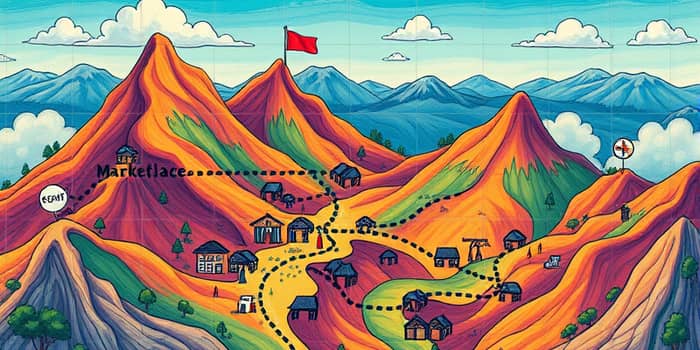
In the intricate world of commerce, trust is not merely a static asset—it is a dynamic landscape to be explored. By envisioning reliability as a terrain, we uncover how every transaction carves a route, every promise kept builds a bridge, and every breach creates a ravine. positive market relationships build relational bonds, laying the groundwork for sustained cooperation and mutual growth.
This article traverses that terrain, drawing on experimental evidence, theoretical frameworks, and practical tools to chart a comprehensive map of trust in market interactions. Whether negotiating face-to-face or engaging through digital platforms, understanding this landscape equips leaders and participants to navigate with confidence, foresight, and resilience.
Understanding Trust as a Terrain
The metaphor of a terrain evokes a richness of elevation, contours, and hidden passages. Trust in markets emerges organically through repeated dealings, much like trails forming across a field. Arrow famously noted that “every commercial transaction has trust at its heart,” reminding us that underwriting deals is akin to forging pathways through uncertainty.
Grounded in Granovetter’s insight on embeddedness, this perspective highlights how social content overlays economic actions. lowering transaction costs significantly, trust reduces the friction of negotiation, aligning incentives and fostering long-term interdependence. Phases of trust-building—exploration, expansion, commitment—mirror the stages of mapping uncharted terrain, from initial footprints to well-worn highways.
Experimental Foundations: Markets Engendering Trust
A seminal laboratory experiment examined how positive and negative experiences in markets shape subsequent trust outside transactional settings. Participants traded as buyers and sellers under two conditions: Market PE (Personal Exchange) and Market IE (Impersonal Exchange). In personal exchanges, parties could see and recognize one another; in impersonal exchanges, interactions were anonymized.
Results revealed that in the personal setting, subjects with prior positive dealings extended significantly more trust and reciprocity than those who experienced defections. Conversely, in the impersonal condition, prior behavior had no detectable impact on subsequent trust levels. These findings demonstrate that markets engender trust through reciprocity when interactions carry a relational imprint—effectively sculpting bonds that endure beyond the marketplace.
Key Factors Shaping Reliability
Trust does not arise in a vacuum. Moorman and colleagues identified a robust set of antecedents driving trust in research–marketing partnerships. Their model situates interpersonal integrity fosters cooperative behaviors at the apex of predictive power, underscoring the centrality of human character.
- Integrity: Consistent alignment of words and actions.
- Expertise: Demonstrated knowledge, skill, and competence.
- Willingness to reduce uncertainty through transparent communication.
- Congeniality and timeliness: courteous, dependable responsiveness.
Organizational culture, interdepartmental power dynamics, and project-level uncertainty also moderate trust, but none rival the weight of direct, interpersonal cues in forging reliable ties.
Components and Dimensions of Market Trust
Beyond antecedent factors lie core dimensions of trust that shape perceptions and behaviors. Buyer–seller relationships often hinge on three intertwined elements:
- Competence: the ability to deliver quality products or services consistently.
- Honesty: truthfulness, transparency, and integrity in all communications.
- Benevolence: goodwill manifested by prioritizing the partner’s interests when possible.
Competence assures partners of reliable outcomes, honesty builds confidence in disclosures, and benevolence fosters the sense that one is valued beyond mere profit—a triad that compasses the heart of durable market relationships.
Mapping Trust: Tools and Scales
To navigate trust’s rugged contours, researchers have developed instruments like the MAPTRUST scale, a twelve-item adjective battery that quantifies perceptions along multiple axes. This approach enables systematic mapping of trust landscapes, translating subjective judgments into actionable data.
The table below illustrates sample MAPTRUST items, each capturing a facet of reliability that can be plotted, compared, and tracked over time.
Institutional and Contextual Moderators
Trust is deeply embedded in broader institutions and social structures. Research shows that market integration across societies predicts variations in generalized trust, as documented by Henrich and colleagues. Meanwhile, Glaeser et al. reveal that social closeness, shared status, and cultural affinity influence baseline expectations of reliability.
Institutions codify norms, creating standardized pathways for trust to flourish. Yet without conscientious stewardship, overly rigid frameworks can obscure individual signals, risking a landscape where rules replace relationships. social context shapes institutional trust, reminding us that architectures of governance must balance formal safeguards with avenues for personal connection.
Implications and Future Directions
For practitioners, these insights translate into actionable strategies: enrich personal exchanges, invest in relationship-specific assets, and deploy clear communication protocols. In digital marketplaces—where anonymity threatens to erode personal ties—designers can integrate rating systems, identity cues, and responsive support to simulate the conditions of personal exchange.
Looking forward, combining behavioral analytics with MAPTRUST measurements promises dynamic, real-time trust maps. AI-driven models may forecast shifts in reliability, flagging emerging risks or opportunities. Such tools can function as compasses, orienting market participants toward collaboration rather than fragmentation.
The metaphor of terrain invites us to recognize trust as ever-shifting, boundary-defining, and deeply contextual. By mapping reliability in market interactions—through experiments, factor models, and measurement scales—we equip ourselves to chart courses through uncertainty, forging pathways that connect, sustain, and elevate our economic endeavors.
Conclusion
Trust’s terrain challenges market actors to appreciate the subtle topography of human exchange. Every handshake, every contract, and every digital endorsement inscribes a mark on this landscape. Embrace the task of mapping reliability, and you transform blind ventures into informed journeys. With a clear map, you do more than transact—you traverse a terrain of promise, understanding, and enduring partnership.
References
- https://pmc.ncbi.nlm.nih.gov/articles/PMC7205303/
- https://www.youtube.com/watch?v=oFakkbceCfc
- https://www.youtube.com/watch?v=Od6fMouhOyw
- https://dl.acm.org/doi/10.1145/3771282
- https://www.jstor.org/stable/1252059
- https://arxiv.org/abs/2503.13793
- https://shs.hal.science/halshs-05332328v1/document
- https://journals.sagepub.com/doi/10.1177/002224299305700106