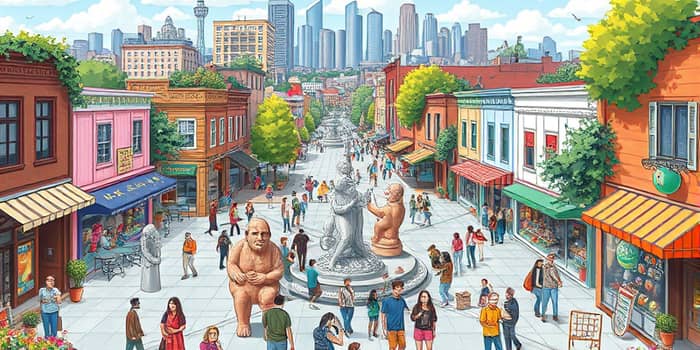
In an age where traditional economic development often centers on manufacturing or technology, the transformative power of the arts remains an underleveraged resource. Like a master sculptor, communities can shape cultural assets into economic engines that generate jobs, revenue, and enhanced quality of life. Drawing on the Arts & Economic Prosperity 6 study and numerous regional examples, this article unveils how data-driven integration of arts and culture drives measurable prosperity.
When we recognize the multiplier effects on society stemming from creative investment, we see arts beyond aesthetics: they become catalysts for tourism, workforce engagement, and urban revitalization. Across small towns and major metropolises alike, arts-centered strategies foster sustainable growth and equitable opportunity.
National and Regional Economic Impacts
The latest nationwide assessment reveals the non-profit arts and culture sector generated $151.7 billion in total economic activity in 2022, supporting 2.6 million jobs and contributing 4.3% of U.S. GDP. Audiences alone spent $78.4 billion on event-related goods and services, highlighting the critical role of arts as a tourism magnet.
Local studies echo these impressive figures. Below is a snapshot of four distinct regions that have harnessed their cultural resources:
These data highlight stark contrasts: Wisconsin invests just 18¢ per capita, while Illinois commits over $5 per person. Meanwhile, Wichita doubled its arts activity since 2017 despite pandemic headwinds, underlining the resilience of place-based creative economic strategies.
Strategies for Integrating Arts into Economic Development
Robust frameworks exist to align cultural assets with broader development goals. A cornerstone approach is a five-step model that embeds arts at every stage:
- Assess strengths and needs, including data-driven economic development initiatives and cultural amenities.
- Build a cross-sector team of local government, industry, academia, and community leaders.
- Craft an actionable plan with clear KPIs, ownership, and timelines.
- Execute programs that link arts institutions with workforce training, infrastructure projects, and tourism campaigns.
- Monitor results and update strategies based on performance metrics and community feedback.
Additionally, disaster recovery funds (HUD CDBG-DR) designate arts as an infrastructure anchor for growth, urging communities to reconstruct commercial and cultural spaces post-crisis. Rural development strategies further recommend data mapping of distressed areas, coupled with public-private partnerships to extend fiber networks, solar energy, and cultural centers to underserved regions.
Moreover, a focus on three core economic strategies amplifies impact:
- Increase GDP by attracting cultural tourists and expanding creative industries.
- Enhance the workforce through arts education, childcare access, and professional mentorships.
- Control inflation by stabilizing local small businesses, which account for 99% of enterprises.
Case Studies in Action
Wichita’s revitalization story exemplifies how targeted arts investment can yield outsized returns. With $78.5 million in nonprofit spending complemented by $106.2 million in audience expenditures, the city fueled 2,929 full-time jobs and added $108.8 million to residents’ incomes.
Chicago’s 1999 “Cows on Parade” public art initiative drew over two million visitors, generating $500 million in tourist spending and boosting sales by 20% at local businesses. One retailer reported an additional $40,000 in profit attributable directly to the exhibit’s foot traffic.
In Florida, arts organizations and patrons combined for $5.8 billion in activity, undergirding 91,270 full-time positions and funneling $694.7 million into government coffers. These statewide results reaffirm that creative investments scale beyond city limits when supported by strategic policy and marketing partnerships.
Challenges and Pathways Forward
Despite clear benefits, many regions underfund their creative sectors. Wisconsin’s meager 18¢ per capita ranking—49th of 50 states—illustrates a pervasive funding gap. Equity remains a critical concern: the most recent national study is the first in 30 years to focus explicitly on underrepresented and diverse communities, aiming to reduce bias in funding allocation.
Addressing this requires policy shifts and community advocacy. Recommended actions include:
- Increase per-capita arts funding to match leading states.
- Incorporate arts metrics into Comprehensive Economic Development Strategies (CEDS) and Smart Growth plans.
- Leverage public-private partnerships, such as gener8tor’s model, to support grassroots cultural entrepreneurs.
- Use AEP6’s online calculator to demonstrate local return on investment for policymakers.
Conclusion
As the data unequivocally show, arts and culture are essential contributors to community prosperity. They generate billions in economic activity, create millions of jobs, and enrich our social fabric. When we view cultural assets through a lens of economic artistry, we unlock pathways to sustainable growth, equitable opportunity, and vibrant public life.
It is time for policymakers, economic developers, and community leaders to invest boldly in the arts. By integrating creative strategies into every facet of planning—from infrastructure to workforce development—we sculpt a future where prosperity flows from the rich tapestry of human expression.
References
- https://www.wichita.gov/166/Arts-Economic-Prosperity
- https://www.hudexchange.info/programs/cdbg-dr/economic-revitalization-guide/introduction/economic-development-strategies-that-work/
- https://wedc.org/the-crucial-role-of-art-in-economic-growth/
- https://envisio.com/blog/5-steps-to-a-successful-economic-development-plan/
- https://www.americansforthearts.org/news-room/americans-for-the-arts-news/groundbreaking-arts-economic-prosperity-6-study-reveals-impact-of-the-arts-on-communities-across
- https://equitablegrowth.org/a-place-based-economic-development-strategy-to-foster-rural-u-s-prosperity/
- https://www.pps.org/article/how-art-economically-benefits-cities
- https://www.bluecapeconomicadvisors.com/post/what-are-the-three-economic-strategies
- https://dos.fl.gov/cultural/info-and-opportunities/resources-by-topic/economic-impact-of-the-arts/
- https://www.socsci.ox.ac.uk/building-stronger-economies-in-resource-rich-countries
- https://www.asiwny.org/arts-economic-prosperity-report/
- https://www.eda.gov/resources/comprehensive-economic-development-strategy
- https://www.youtube.com/watch?v=GXkSY2RxqXo
- https://www.epa.gov/smartgrowth/framework-creating-smart-growth-economic-development-strategy
- https://www.giarts.org/article/economics-arts-artists-and-culture