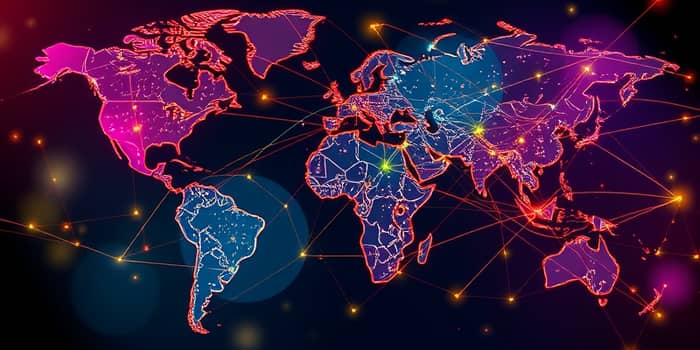
Markets are more than centers of commerce; they are the unseen fabric of our existence. From the coffee in our morning cup to the smartphone in our hand, economies knit people, places, and ideas into a vast tapestry of interdependence. By understanding these systems of voluntary exchange, we can appreciate how markets shape everyday life, politics, and resilience.
Markets as Invisible Connective Tissue
At its core, a market forms when buyers and sellers interact, determining prices and allocating scarce resources. Through specialization and comparative advantage, individuals and nations focus on producing what they do best and trade for the rest. These exchanges create a network of prices, contracts, expectations, norms, and information flows that coordinate billions of decisions without any central planner.
- Prices as signals guiding production and consumption
- Contracts and expectations building trust across distances
- Social norms shaping market behavior
- Information flows linking suppliers, investors, and consumers
Globalization and Economic Interdependence
Economic interdependence describes the intricate web of connections between economies, reflecting their mutual reliance on trade, investment, and finance. No nation is self-sufficient; every country needs imports for growth and exports to balance its accounts. This dynamic underpins modern globalization, encompassing:
- Trade in goods and services
- Cross-border investment and financial linkages
- Policy coordination among governments
Global value chains now stretch across continents, allowing raw materials, components, and ideas to flow seamlessly. While this boosts material living standards, it also amplifies how shocks—like political disruptions or natural disasters—propagate worldwide.
Market Connections in Everyday Life
Consider the humble coffee bean: grown on sunlit plantations in Latin America or Africa, it travels thousands of miles through shipping lanes, processing plants, and retail outlets before reaching your cup. Likewise, bananas, cocoa, and spices sprout distant fields but enrich kitchens everywhere. This is specialization in practice, uniting farmers and consumers across oceans.
Electronics and modern medicines are even more entangled. Semiconductors might begin as sand in one region, undergo chip fabrication in another, and be assembled on yet another continent. Pharmaceuticals often involve research in Western labs, active ingredients from Asia, and final packaging elsewhere. The COVID-19 pandemic exposed both the strengths and limitations of these networks: rapid innovation and mass production contrasted with bottlenecks in critical supplies.
The Social and Psychological Dimensions of Connection
Just as invisible threads are the strongest ties in social relationships, the unseen bonds of markets shape our collective well-being. Studies show that strong social connections reduce health risks and strengthen communities. Economically, market ties influence opportunity and vulnerability: a factory closure due to foreign competition can ripple through local families, while new export markets can lift entire regions out of poverty.
Economic and social threads intertwine: job loss from trade shocks can harm mental health, and conversely, inclusive economic growth can foster social cohesion. Recognizing this interplay encourages policymakers to craft strategies that balance efficiency with human dignity.
Resilience, Self-Reliance, and Shared Risks
While interdependence brings benefits, it also creates shared risks and rewards. The surge in great-power competition and economic nationalism has prompted nations to reconsider supply-chain priorities. Cost efficiency gives way to security and resilience as countries seek to safeguard critical industries like medical supplies, semiconductors, and energy.
During the pandemic, governments enacted measures to accelerate domestic production of essential items. The European Union proposed a Critical Medicines Act, while the United States invoked emergency powers to shore up medical supply chains. Such shifts promise greater preparedness but can also raise costs and reshape global market dynamics.
At the global level, a draft pandemic treaty under the World Health Organization embraces the principle of common but differentiated responsibilities and capabilities. It calls for strategic stockpiles and regional cooperation, reflecting the tension between national self-reliance and global solidarity.
Charting a Path Forward
Understanding these invisible threads empowers individuals, businesses, and governments to make informed choices. Consumers can support ethical sourcing and resilient supply chains. Companies may diversify suppliers and invest in local capacities. Policymakers should foster open trade while building buffers—strategic reserves, flexible regulations, and social safety nets—that mitigate shocks.
Equally important is investing in human capital. By enhancing education, workforce training, and digital infrastructure, societies strengthen their ability to adapt to shifting market demands.
As markets bind us in unseen ways, they also offer a foundation for cooperation. Embracing economic interdependence with responsibility can unlock prosperity while building a more resilient, inclusive world.
In the tapestry of global commerce, each thread matters. By nurturing these connections thoughtfully, we weave a future of shared opportunity, innovation, and solidarity.
References
- https://www.virtualrealitymarketing.com/company/invisible-thread/
- https://www.hilarispublisher.com/open-access/economic-interdependence-in-a-globalized-world-108421.html
- https://www.barberassociates.co.uk/blog/why-connecting-with-others-is-crucial-and-how-to-do-more-of-it
- https://www.thinkglobalhealth.org/article/balancing-global-interdependence-and-self-reliance
- https://www.artdoc.photo/online-exhibition/invisible-threads
- https://applications.education.ne.gov/distrib/web/social_studies/CSSAP%20Modules/CSSAP%20First%20Phase%20Modules/GlobalTrade/index.html
- https://katewoodsome.substack.com/about
- https://marianeibrahim.com/video/29-invisible-threads-are-the-strongest-ties-ayana-v.-jackson/
- https://ideas.repec.org/a/arp/ijefrr/2017p202-205.html
- https://www.youtube.com/watch?v=2OO-FSdMJlM
- https://invisiblethread.com/about/