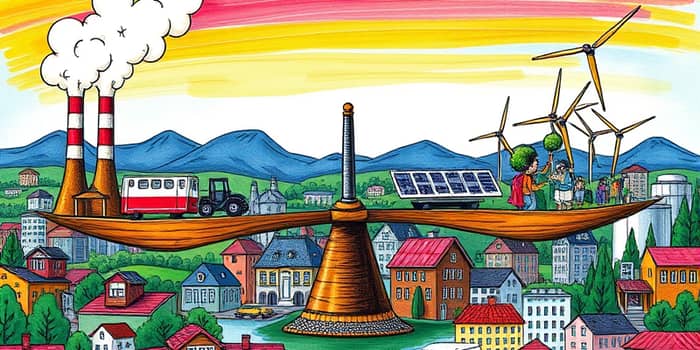
In modern economies, free markets fail to allocate resources efficiently when private incentives diverge from society’s best interests. These breakdowns—known collectively as market failures—create gaps between individual decisions and collective welfare, leading to environmental harm, underinvestment in public goods, and widening inequality.
Understanding how markets deviate from theoretical ideals is the first step toward crafting targeted remedies. By exploring core types, real–world consequences, and practical interventions, policymakers and citizens alike can balance both efficiency and social equity more effectively.
Understanding Market Failures
Market failures arise because market prices do not fully reflect social costs or benefits. Whether due to unpriced environmental damage, the underprovision of shared goods, or distortions from concentrated power, these failures hamper long–term growth and equitable opportunity.
At the heart lies unpriced external effects due to incomplete property rights: when the behavior of firms or consumers imposes costs or benefits on others without compensation, markets alone struggle to correct the imbalance.
Main Types of Market Failure
Economists classify market failures into several interrelated categories. Each highlights a distinct mechanism by which private transactions deviate from socially optimal outcomes:
- Externalities: Costs or benefits affecting third parties that are not captured in market prices, leading to overproduction of harmful goods or underproduction of beneficial ones.
- Public Goods: Characterized by non-excludable and non-rivalrous goods, these assets suffer from free–rider problems and rarely attract private investment.
- Information Asymmetries: When buyers or sellers hold unequal information, markets risk adverse selection and moral hazard, as seen in used car markets or health insurance.
- Market Power: Monopolies or oligopolies distort prices and output, generating deadweight losses and stifling innovation.
- Equity Concerns: Even well–functioning markets can exacerbate income and wealth gaps, limiting access to essential goods for low–income groups.
- Common Pool Resources: Shared assets like fisheries or forests face overuse due to the tragedy of the commons, depleting resources over time.
Consequences of Inefficient Markets
Unchecked market failures impose significant social and economic costs. Pollution externalities degrade air and water quality, driving up healthcare expenses and ecological damage. Public goods—such as national defense, clean air, and basic research—remain chronically underfunded without collective action.
Monopolistic practices lead to higher prices and restricted output, reducing consumer welfare. Information gaps undermine trust in markets, while inequities in income distribution create barriers to education, healthcare, and housing. Left unresolved, these distortions can deepen cycles of poverty and environmental decline.
Policy Solutions and Interventions
Governments and institutions deploy a range of tools to correct market failures and behavioral biases and irrational decision-making. By aligning private incentives with social objectives, these interventions restore balance and spur sustainable growth.
Role of Private and Hybrid Approaches
Beyond public sector tools, private solutions and market–based hybrids can offer cost–effective remedies, particularly when transaction costs are low. The Coase theorem for low transaction costs suggests that clearly defined property rights and bargaining can resolve externalities without heavy regulation.
- Private Contracts and Liability: Firms negotiate compensation agreements to internalize third–party impacts.
- Patents and Licensing: Temporary monopolies incentivize R&D while maintaining competitive markets.
- Cap-and-Trade Schemes: Combine government oversight with market pricing to limit pollution.
Striking the Balance
No single approach offers a universal fix. Effective policy requires careful calibration of taxes, subsidies, regulations, and property rights—alongside ongoing evaluation to avoid unintended distortions. Moreover, democratic engagement ensures that interventions reflect diverse perspectives, helping to balance both efficiency and social equity in practice.
As societies grapple with climate change, technological disruption, and rising inequality, understanding market failures and their remedies is more critical than ever. By combining rigorous analysis with flexible, context–specific solutions, we can build economies that are more resilient, inclusive, and aligned with the public good.
References
- https://www.economicshelp.org/micro-economic-essays/marketfailure/government-policies/
- https://www.ebsco.com/research-starters/business-and-management/market-failure
- https://en.wikipedia.org/wiki/Market_failure
- https://www.indeed.com/career-advice/career-development/what-is-market-failure
- https://www.edchoice.org/defining-market-failure-with-examples/
- https://corporatefinanceinstitute.com/resources/economics/market-failure/
- https://opportunityinstitute.org/blog/post/econ-101-market-failures/
- https://www.youtube.com/watch?v=Ssfi2KQgH5M
- https://books.core-econ.org/espp/book/text/11.html
- https://www.econlib.org/library/Topics/College/marketfailures.html