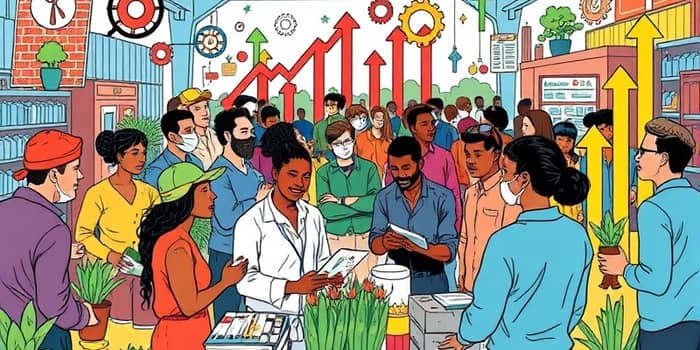
In today’s fast-evolving global economy, organizations and communities thrive when they unleash untapped human potential. At its core, human capital reflects the collective knowledge, skills, experience, attributes, and health of every individual. Far beyond a mere resource, it constitutes roughly two-thirds of an individual’s wealth, with work experience accounting for nearly half of that value. By understanding and investing in this vital asset, market systems can ignite innovation, drive productivity, and foster lasting empowerment.
Understanding Human Capital and Its Impact
Human capital captures both formal education and the lessons learned on the job. In traditional economic models, it augments labor’s marginal product, but a task-based perspective reveals even deeper insights. Under this approach, workers allocate their time across diverse tasks, where core cognitive abilities boost performance universally, and higher-order skills guide task selection, teamwork, and strategic decision-making.
Across industries, workplaces that acknowledge this dynamic see employees complete assignments faster and with fewer errors. Whether closing a high-value deal or designing a new product, workers with robust human capital can deliver superior outcomes, propelling both individual careers and organizational success.
Driving Sustainable Growth in Market Systems
Market systems thrive when companies deliberately recruit, train, and empower their workforce. In the United States alone, the private sector contributes nearly four trillion dollars annually toward worker empowerment. This investment spans wages, benefits, and philanthropic efforts that lift employees above basic needs and unlock potential.
- Subsidized healthcare and living wages
- Reskilling and upskilling programs for higher incomes
- Fair supply chain wages, as exemplified by corporate commitments through 2030
- Employee development and mentorship initiatives
- Philanthropic partnerships to support community well-being
By providing these opportunities, organizations not only reduce turnover and enhance loyalty but also cultivate a workforce aligned with long-term strategic goals and customer trust.
Building Value Through Experience and Skills
Work experience is the crucible in which theoretical knowledge transforms into practical expertise. On-the-job learning, structured employer programs, and purposeful job transitions all contribute to this process. As employees accumulate years of practice, they build an intimate understanding of industry nuances, workflows, and client needs.
In emerging economies, the stakes are especially high: over the next decade, more than 1.2 billion young people will enter working age, yet only 420 million new jobs are projected, threatening uncertainty for hundreds of millions. Recognizing this, 92 percent of employers have prioritized reskilling by 2030, aiming to align workforce capabilities with evolving industry demands.
Such efforts create holistic workforce development for lasting change, enabling individuals to navigate shifting markets and seize new opportunities.
Key Statistics and Economic Impacts
Confronting Challenges: Engagement and Productivity
Despite progress over recent years, global employee engagement plummeted to just 20 percent in 2025—the lowest since 2020. This decline, driven largely by management disengagement, translates into billions of dollars in lost productivity and slowed economic growth.
- Low manager engagement diminishing team morale
- Informal employment limiting access to benefits
- High turnover rates inflating recruitment costs
- Skill mismatches in rapidly changing industries
Failing to address these issues risks undermining both individual livelihoods and the broader economic fabric.
Strategies for Empowerment and Development
To reverse these trends and empower every individual to thrive, organizations can lean on proven frameworks and innovative tools. Three foundational pillars guide this journey: leadership quality, talent acquisition, and retention as an embedded cultural platform.
Key actions include the following:
- Implementing centralized Human Capital Management systems to streamline recruitment, onboarding, and career development
- Launching reskilling and upskilling initiatives in AI, data literacy, and emerging technologies
- Partnering with educational institutions for tailored workforce academies
- Establishing living wage policies and benefits tailored to diverse workforce needs
- Prioritizing equity in hiring, compensation, and leadership opportunities
- Employing granular metrics and talent KPIs tied to financial forecasts
Through these steps, companies can invest in lasting competitive advantage while fostering inclusive, high-performing teams.
Future Trends and the Road Ahead
As we look toward 2030 and beyond, several macro drivers will reshape the landscape of work and human capital:
• Technological Innovation: AI, robotics, and digital platforms will redefine roles and productivity benchmarks. • Green Transition: Energy technologies will create new skill demands and sustainable job opportunities. • Demographic Shifts: Growing working-age populations will intensify competition for quality employment. • Geoeconomic Flows: Global supply chains and remote work will broaden talent pools and spark new collaborations.
According to recent surveys, seven out of ten business leaders plan to prioritize Human Capital Management as their primary competitive strategy over the next three years. By embracing these trends, organizations can transform lives and economies sustainably and unlock the full potential of their people.
Ultimately, investing in human capital is more than a cost—it is a powerful engine for growth, resilience, and shared prosperity. By designing market systems that value knowledge, skills, and well-being, we can create a virtuous cycle of empowerment that benefits individuals, organizations, and societies at large.
Let us commit today to nurture our greatest asset—our people—and build a future where everyone has the opportunity to flourish.
References
- https://www.mckinsey.com/capabilities/people-and-organizational-performance/our-insights/human-capital-at-work-the-value-of-experience
- https://www.gallup.com/workplace/349484/state-of-the-global-workplace.aspx
- https://www.sandscapital.com/human-capital-as-a-competitive-advantage/
- https://www.mckinsey.com/mgi/our-research/economic-empowerment-made-to-measure-how-companies-can-benefit-more-people
- https://www.weforum.org/publications/the-future-of-jobs-report-2025/in-full/1-drivers-of-labour-market-transformation/
- https://www.ukg.com/learn/article-library/hr-leaders/what-human-capital-management-system
- https://worksystems.org/the-regional-labor-market/
- https://financialmodelslab.com/blogs/blog/value-business-human-capital
- https://www.wellington.com/en/insights/human-capital-management-hcm-strategies
- https://www.mywestford.com/blog/importance-of-human-capital-in-an-organization/
- https://www.deloitte.com/us/en/insights/topics/talent/human-capital-trends.html