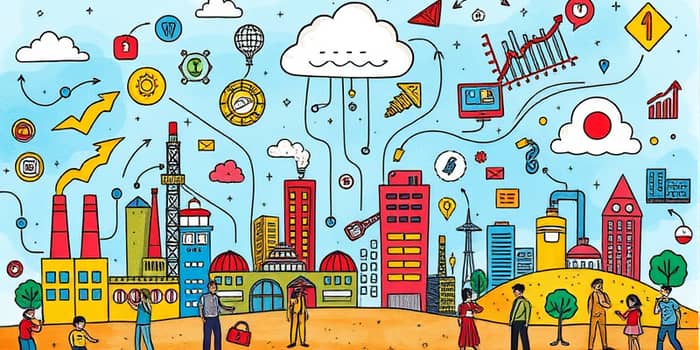
In an era defined by relentless change, industries are being reinvented from the ground up. From manufacturing floors to consumer markets, groundbreaking forces are rewriting the rules of competition and value creation.
Macro Context: Forces Expanding Disruption’s Reach
Disruption is no longer confined to tech startups—it’s a revolution no less radical than the Industrial Revolution itself. Structural trends are converging to reshape every sector.
- Digitalization & Connectivity: Ubiquitous smartphones, cloud computing, 5G, IoT create always-on ecosystems.
- Empowered Consumers: Experience-driven buyers demand personalization, ethics, sustainability, and even co-creation roles.
- Disruptive Technologies: AI, robotics, additive manufacturing, blockchain drive new services and near-zero replication costs.
- Industry Convergence: Cascading breakthroughs turn silos into interconnected ecosystems, compounding innovation.
- Geopolitics & Resilience: Trade tensions and pandemics force regionalized supply chains and flexibly digital footprints.
- Sustainability & Social Impact: Circular economy models prioritize resource efficiency and inclusive growth.
According to WEF, "Consumer industries will change more in the next 10 years than in the last 40", underlining the magnitude of this shift. McKinsey estimates technology enablement in industrial services can generate $40–110 billion in revenue growth and $40–60 billion in margin expansion globally.
What Exactly Is Disruption?
Clayton Christensen’s seminal work distinguishes disruptive innovation from sustaining improvements. While sustaining innovations enhance performance for existing customers, disruptive innovations radically alter the basis of competition.
They begin as inferior solutions by traditional metrics but excel on new values—like convenience, accessibility, or affordability—gradually improving until they overtake incumbents. This often happens in four stages:
Examples range from Netflix streaming redefining on-demand entertainment to Southwest Airlines upending air travel with low-cost, no-frills service.
Reshaping Operating Models from the Inside Out
Digital disruption forces companies to reinvent their purpose, processes, and partnerships. Traditional functions give way to data-driven, externally oriented ecosystems where agility and collaboration reign.
Key shifts include:
- From vertical integration to platform orchestration, leveraging partner networks rather than doing everything in-house.
- From product-centricity to experience-centric offerings, designing end-to-end journeys with omnichannel touchpoints.
- From static planning to rapid, iterative experimentation and continuous deployment fueled by real-time customer feedback.
Manufacturing exemplifies this transformation through Industry 4.0. Cyber-physical systems, digital twins, AI analytics, and additive manufacturing enable smart factories that optimize processes in real time.
Companies are redesigning footprints in response to geopolitical risk, labor shifts, and ESG mandates. Factories are sited closer to customers for faster delivery, while robotics and automation lessen dependence on low-cost labor. Outcome-based contracts and data monetization turn equipment into service platforms, aligning incentives around uptime and performance.
New Business Model Archetypes Redefining Industries
Disruption is birthing fresh business model archetypes that challenge legacy logic. Companies embracing these models are gaining strategic advantage and inspiring entire sectors to follow suit.
- Everything-as-a-Service (XaaS): Transitioning from selling products to delivering outcomes and experiences. Rolls-Royce’s “power by the hour” and equipment-as-a-service in manufacturing illustrate this shift.
- Platform Ecosystems: Orchestrating multi-sided networks where value is co-created by partners, developers, and end users. Examples include Amazon Web Services and Apple’s App Store.
- Data Monetization & AI-Driven Insights: Turning operational data into new revenue streams through analytics services, predictive maintenance, and performance guarantees.
- Circular and Inclusive Models: Designing for reuse, remanufacturing, and social impact, as seen in leasing platforms for electronics and community-based microgrid initiatives.
These archetypes are not mutually exclusive. Leading organizations combine elements to craft hybrid approaches—blending servitization with platform orchestration and circularity—to maximize resilience and growth.
Practical Steps for Leaders Navigating Disruption
To thrive amid accelerating change, executives should consider the following actions:
- Map your current operating model against emerging archetypes to identify gaps and opportunities.
- Invest in digital infrastructure—cloud, edge computing, IoT—to build real-time visibility and agility.
- Develop an ecosystem strategy: partner with startups, academia, and even competitors to co-innovate.
- Re-skill your workforce around data literacy, agile methods, and cross-functional collaboration.
- Embed sustainability and inclusivity into product and service design to meet rising consumer expectations and regulatory pressures.
Conclusion: Seizing the Disruption Dividend
Disruption’s footprint will only expand as technological, societal, and environmental forces intensify. Leaders who view change as an opportunity rather than a threat can rewrite industry rules, unlock new revenue streams, and build lasting competitive advantage.
By embracing platform orchestration, servitization, and circular innovation, organizations can not only survive but flourish—creating value for shareholders, society, and the planet in equal measure.
References
- https://www.weforum.org/stories/2017/08/disruption-in-consumer-industries-turning-the-operating-model-inside-out/
- https://kaizen.com/insights/business-models-industry-40/
- https://www.globalxetfs.com/articles/introducing-charting-disruption-outlook-for-2026-and-beyond/
- https://www.trueprojectinsight.com/blog/aits/disruptive-business-models
- https://www.burrus.com/your-blueprint-for-turning-disruption-into-opportunity/
- https://www.3ds.com/manufacturing/trends/business-model-transformation
- http://innovationfootprints.com/notes-on-strategy-where-does-disruption-come-from/
- https://dobetter.esade.edu/en/emergence-new-business-models
- https://www.youtube.com/watch?v=UeS9UG0i9nw
- https://www.maxio.com/blog/6-companies-that-succeeded-by-changing-their-business-model
- https://www.mckinsey.com/capabilities/operations/our-insights/decoding-disruption-to-reshape-manufacturing-footprints
- https://www.netnetweb.com/content/blog/top-5-industries-transforming
- https://www.deloitte.com/us/en/insights/industry/manufacturing-industrial-products/industry-4-0/industry-4-0-business-models.html
- https://www.frost.com/growth-opportunity-news/techvision/15-years-of-technology-disruption-the-evolution-of-the-top-50-technologies-igfr-cim-sn/