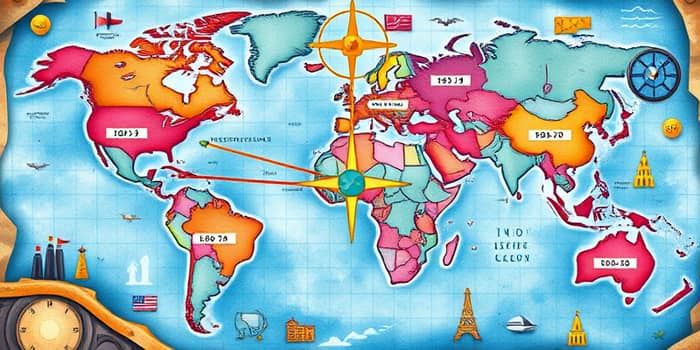
In an age of rapid change, your financial journey resembles an unfolding map: shifting terrains of global growth, evolving technologies, and generational currents all demand careful navigation. This guide serves as your compass, charting 2026 forecasts, industry disruptions, intergenerational wealth shifts, and strategic themes that will define tomorrow’s portfolios.
Forecasting the 2026 Global Economy
As we peer into 2026, economists offer a mixed portrait of growth and inflation. A robust United States contrasts with subdued Europe and emerging pressures on lower-income households worldwide. Understanding these dynamics forms the foundation of a resilient strategy.
Global GDP forecasts range from 2.7% to 2.9%, while headline inflation eases slightly to around 3.1%. Central banks in major markets move cautiously, balancing rate cuts with risks of rising deficits and trade tensions. Below is a concise summary of regional projections:
While headline inflation moderates, the persistent cost-of-living squeeze erodes real incomes for vulnerable groups. Geographic disparities intensify as Asia and the US outpace Europe and many developing markets.
Phases of Wealth Management Disruption
Wealth management has transformed in successive waves, each recalibrating how clients engage with their assets. Recognizing these stages empowers advisors and individuals to adopt the right tools and partners.
- Digital channels: browser and phone access to traditional services, emphasizing convenience and self-service.
- Native internet models such as robo-advice, reducing costs for basic portfolios but facing scalability challenges in client acquisition.
- Aggregation and embedded offerings, integrating wealth into super apps, health platforms, and employee benefits amid a “poverty of attention” landscape.
Asia’s rapid digital adoption illustrates the urgency for transformation. Legacy sourcing, distribution, and operations must yield to vendors and platforms that act as true “transformers,” enabling business model reinvention and future readiness.
Intergenerational Wealth Transitions
By 2030, trillions of dollars will shift from Baby Boomers to Gen X and Millennials, reshaping preferences and priorities. Younger high-net-worth individuals (HNWIs) exhibit distinct behaviors:
They favor ethical global investing preferences, emphasizing environmental, social, and governance criteria at roughly twice the rate of their predecessors. Geographical bias declines as portfolios diversify, tapping opportunities across Asia, North America, and beyond.
Concerns also diverge: 60% of younger investors worry about financial security in a tight job market and rising living costs, compared to about 30% of Boomers. Yet confidence remains high: over 80% expect to meet long-term goals, demanding flexibility and responsiveness in portfolios.
Investment Compass: Themes and Strategies for 2026
In uncertain waters, thematic anchors can guide allocation decisions. Morgan Stanley’s key themes serve as compass points:
- Enduring opportunity in AI technologies: Thematic equities soared 38% in 2025, outperforming major benchmarks by wide margins.
- Future of energy, encompassing renewables, grid upgrades, and transition metals.
- Multipolar world dynamics, navigating geopolitical realignments and regional supply chains.
- Societal shifts, from aging demographics to AI labor impacts and evolving consumer behavior.
Beyond themes, core strategies for resilient portfolios include: private markets exposure for diversification, selective fixed-income in anticipation of rate cuts, and model portfolios tuned to multi-asset and alternative allocations. Diversification and selectivity key to balancing growth with risk management.
Charting the Course: Tools and Considerations
To translate insights into action, advisors and individuals should leverage analytics, risk engines, and digital platforms that offer personalization at scale. Key considerations include:
- Assessing model portfolio providers on governance, transparency, and rebalancing frameworks.
- Monitoring cost structures to ensure technology-driven efficiency gains are passed through to clients.
- Embedding ESG and impact metrics seamlessly into reporting and decision processes.
Funding landscapes also evolve. Over 2,000 new financial inclusion providers emerged recently, reflecting broadening access and innovation beyond traditional banking. This proliferation underscores the need for discernment in partner selection.
Ultimately, your wealth map is not static. It requires ongoing calibration as AI advances, inflation ebbs and flows, demographic tides shift, and new risks emerge. By charting forecasts alongside disruption phases, intergenerational insights, and thematic compasses, you position yourself to navigate complexity with clarity.
Embrace the wealth map—a dynamic blueprint that adapts as economies, technologies, and societies evolve. With informed strategies, resilient tools, and a forward-looking mindset, you can traverse the economic landscapes of 2026 and beyond, turning uncertainty into opportunity.
References
- https://www.thewealthmosaic.com/vendors/the-wealth-mosaic/twm-articles/a-new-map-for-navigating-a-changing-wealth-managem/
- https://www.goldmansachs.com/insights/articles/forecasts-for-the-worlds-biggest-economies-in-2026
- https://www.rbcwealthmanagement.com/en-us/insights/the-shifting-landscape-of-global-wealth
- https://www.morganstanley.com/insights/articles/investment-outlook-shaping-markets-2026
- https://www.mckinsey.com/industries/financial-services/our-insights/us-wealth-management-in-2035-a-transformative-decade-begins
- https://www.columbiathreadneedle.com/en/global-outlooks-2026/
- https://www.troweprice.com/financial-intermediary/us/en/insights/articles/2024/q3/navigating-the-model-portfolio-landscape.html
- https://unctad.org/publication/world-economic-situation-and-prospects-2026
- https://www.cgap.org/research/publication/widening-lens-mapping-evolving-landscape-of-financial-inclusion-funders
- https://www.msci.com/research-and-insights/research-reports/2026-wealth-trends
- https://nonprofitresourcehub.org/2026-economic-outlook-moderate-growth-in-a-shifting-landscape/
- https://www.wealthenhancement.com/advisor-teams/amr/2026-10-economic-and-market-predictions