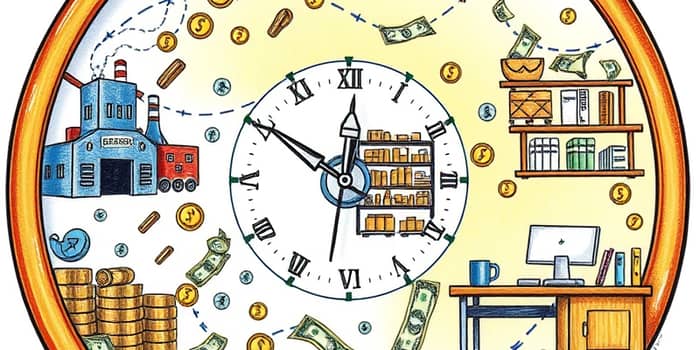
Every business relies on a steady rhythm of cash entering and leaving to thrive. Understanding the path your money travels—from outlay to return—can empower you to make smarter decisions, optimize liquidity, and fuel sustainable growth.
What Is a Cash Flow Cycle?
A cash flow cycle is the journey cash takes through a business, tracing money from the moment it leaves your account to purchase inputs all the way to when it returns from customer payments. It highlights how long cash is tied up in operations and measures the efficiency of your inventory, receivables, and payables management.
This concept is often called the cash conversion cycle (CCC) or cash-to-cash cycle time. A shorter cycle means your cash returns faster, whereas a longer cycle can strain liquidity and force reliance on external financing.
Main Components of the Cycle
- Inventory: Time inventory sits before sale.
- Accounts Receivable: Time to collect payment from customers.
- Accounts Payable: Time taken to pay suppliers.
These three elements form the backbone of working capital analysis. By monitoring each, businesses can pinpoint bottlenecks and unlock trapped cash.
Calculating the Cash Conversion Cycle
The core formula to measure the cycle is simple:
CCC = DIO + DSO - DPO
Where:
Interpretation hinges on the CCC value. A high CCC indicates cash is tied up longer, requiring more working capital. A low or negative CCC suggests efficient operations or business models where payment collection precedes supplier payment.
Why Cash Flow Cycles Matter
Monitoring your cash flow cycle reveals how effectively your business transforms outflows into inflows, shining a spotlight on potential liquidity challenges. Small enterprises, in particular, cannot afford a misstep in timing: slow-paying clients or excess inventory can quickly create cash shortages.
Understanding the cycle enables you to:
- Forecast working capital needs accurately
- Reduce reliance on credit and emergency financing
- Optimize operational efficiency and profitability
Strategies to Improve Your Cash Flow Cycle
By implementing targeted levers, you can significantly shorten your cycle and free up cash for growth.
- Collect faster: Invoice promptly, tighten credit terms, offer early payment discounts, and follow up diligently.
- Manage inventory efficiently: Reduce excess stock, avoid over-ordering, improve demand forecasting, and accelerate turnover.
- Optimize payables: Negotiate longer payment terms, pay on due dates rather than early, and nurture strong supplier relationships.
As one succinct mantra reminds business leaders: buy low, sell high, collect early, pay late. Balance remains key—extending payables too far without respect for suppliers can harm long-term partnerships.
Beyond the Cycle: Broader Cash Flow Management
While the cash flow cycle zeroes in on operational timing, cash flow management spans the full ecosystem of inflows and outflows. It includes forecasting, reporting, financing decisions, and investing activities outside day-to-day operations.
Think of cash flow management as the overall discipline and the cash flow cycle as a vital metric within that discipline, guiding your strategic decisions and preserving financial flexibility.
Real-World Examples
Example 1: Retail Business
A small boutique orders seasonal inventory on credit. Inventory sits in the back room, then on the floor, before sales occur. Customers often pay immediately, but the boutique may delay supplier payments. Tracking DIO, DSO, and DPO reveals how long cash remains inaccessible and drives adjustments to reduce stockholding and tighten collection terms.
Example 2: Service Business
With minimal inventory, a consulting firm’s cash flow cycle hinges on billing speed and payment collection. By standardizing invoices and imposing stricter payment deadlines, the firm slashes DSO, ensuring cash returns before hefty overhead bills are due.
Key Elements of Strong Cash Flow
- Projected sales growth
- Gross margins
- Overhead expenses
- Payment and collection systems
- Capital expenditures and debt structure
Each driver ties back to the cash conversion cycle. Robust sales can boost inflows but may require more inventory. Improving gross margins leaves more cash after costs, and efficient collection systems directly shrink DSO.
Final Thoughts
Mastering your cash flow cycle transforms how you view working capital. By measuring the cash gap between outflow and inflow, you gain the power to streamline operations, avoid cash crunches, and invest confidently in growth opportunities.
Start today by mapping your own cycle’s components, running the CCC formula, and implementing small but meaningful process improvements. Your business will enjoy stronger liquidity, reduced financing costs, and the freedom to pursue your next big ambition without the burden of preventable cash constraints.
References
- https://www.syncupbookkeeping.com/glossary/c/cash-flow-cycle
- https://pnfp.com/learning-center/business-resource-center/articles/finance-and-money-matters/5-key-elements-of-strong-cash-flow/
- https://www.warehousequote.com/resources/cash-to-cash-cycle-times
- https://www.jpmorgan.com/insights/treasury/forecasting-planning/cash-flow-management-and-reporting-guide-for-businesses
- https://www.youtube.com/watch?v=rNjMWAOJHwM
- https://prioritycommerce.com/resource-center/what-is-cash-flow-management/
- https://edgewatercpa.com/blog/understanding-the-cash-conversion-cycle/
- https://www.venasolutions.com/blog/what-is-a-cash-flow-statement
- https://www.settle.com/blog/what-is-the-cash-conversion-cycle
- https://www.pioneerny.com/financial-education/business/building-your-business/the-basics-of-cash-flow-management
- https://corporatefinanceinstitute.com/course/cash-flow-cycles-and-analysis/
- https://www.yoh.com/resources/blog/cash-flow-management-101
- https://study.com/academy/lesson/video/operating-cycle-cash-cycle-definition-calculations.html
- https://squareup.com/us/en/the-bottom-line/managing-your-finances/cash-flow-management
- https://aofund.org/resource/what-is-cash-flow-management/