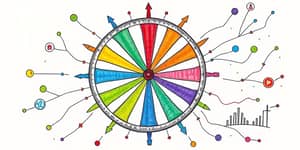
The economy resembles a majestic symphony, where billions of individual decisions coalesce into an ever-evolving performance. Just as an orchestra requires skilled players and a guiding conductor, the market depends on diverse agents governed by the price mechanism. In this article, we explore how consumers, producers, institutions, and emerging AI participants collaborate in a complex adaptive system, producing both harmony and occasional dissonance. By understanding each role and the dynamics at play, we can better appreciate the beauty and challenges of a dynamic economic ecosystem.
The Orchestra Members
Every market performance depends on a diverse cast of participants. These include families seeking goods, companies producing services, investors allocating capital, and regulators setting the stage.
- Consumers: Individuals and households whose preferences drive demand.
- Producers: Businesses and entrepreneurs innovating to meet needs.
- Financial institutions: Banks, funds, and markets facilitating capital flow.
- Public administrations: Governments crafting rules and safeguards.
Each agent carries unique attributes—behavioral norms, learning capabilities, stored information—and contributes distinct voices to the market’s grand score.
The Conductor's Baton: Price Mechanism and Information Flow
In any orchestra, the conductor’s baton shapes tempo and harmony. In markets, prices perform that role, communicating scarcity, surpluses, and opportunities.
When demand rises, prices increase, signaling producers to expand output. Conversely, price declines inform suppliers to scale back. This real-time information coordination allows decentralized agents to align their actions without central planning.
Through countless local interactions, entrepreneurs learn consumer preferences, refining products and driving the discovery process Hayek championed. Prices thus serve as the invisible hand’s baton, guiding each section of the ensemble toward balanced performance.
The Symphony's Score: Supply, Demand, and Market Dynamics
The core motifs of the market’s symphony are supply and demand. Buyers and sellers engage in continual negotiation, producing emergent macroeconomic patterns.
Decentralized transactions generate complex feedback loops: micro-level decisions aggregate into macro structures, which in turn influence individual behavior. This two-way feedback loop defines markets as complex adaptive systems, where network interactions create stability and occasional upheaval.
Over time, markets tend to cluster around attractors—equilibrium states—yet remain sensitive to shocks. Technological innovations, policy shifts, and global events introduce new melodies and dissonant notes, keeping the composition ever-evolving.
Individual Solos: Entrepreneurship, Innovation, Competition
Within the ensemble, soloists emerge. Entrepreneurs act as virtuoso performers, improvising new themes and driving progress.
- They respond swiftly to changing tastes and unmet needs.
- Competition fosters a perpetual cycle of improvement, pushing quality and efficiency.
- AI-driven agents learn through trial and error, simulating market strategies in virtual concert halls.
Agent-based experimental economics (ABEE) blends neoclassical theory, Austrian insights, and AI to simulate markets where agents learn and adapt. These simulations reveal how markets can converge to equilibrium even under limited information.
Tuning the Instruments: Regulatory Framework and Safeguards
Even the finest orchestra needs tuning. Governments and institutions provide antitrust laws, environmental regulations, and social policies to correct market failures.
Without safeguards, monopolistic tendencies may silence competition, and profit pursuits may compromise ethics. Environmental degradation and income inequality highlight the balancing act between freedom and responsibility.
- Antitrust measures prevent dominance and protect consumers.
- Redistributive tax-benefit systems promote equity.
- Corporate social responsibility fosters long-term viability.
Thoughtfully designed policy interventions ensure the ensemble performs in harmony with societal values.
The Ensemble Effect: Emergent Properties of Complex Systems
A symphony transcends individual contributions—its beauty lies in the interplay. Similarly, markets exhibit emergent properties arising from decentralized interactions.
Local decisions by millions of agents generate macroeconomic regularities such as business cycles and price clusters. This collective behavior emerges without a central controller, showcasing the power of decentralized coordination.
As institutions coevolve with agent behaviors, new patterns form, illustrating markets as ongoing discovery processes rather than static constructs.
Dissonant Notes: Market Failures and Externalities
No performance is flawless. Markets may falter when externalities, information asymmetries, or monopolies distort incentives.
Addressing these challenges requires calibrated intervention, ensuring markets remain vibrant while safeguarding public welfare.
Modern Composition: AI Agents and the Agentic Economy
The next movement embraces AI and the agentic economy. Programmatic and assistant agents interact on behalf of humans, automating transactions and services.
By representing consumers and businesses, AI agents promise streamlined operations and novel products. Yet governance and ethical considerations are crucial to prevent misuse or concentration of power.
This new frontier of programmatic economic interactions has the potential to reorganize markets, redistribute influence, and spark innovative service offerings.
Finale: Balancing Harmony and Sustainability
As the final chord resonates, the challenge remains: how to maintain a market orchestra that is both innovative and inclusive?
Striking the right balance between autonomy and regulation, efficiency and equity, entrepreneurship and responsibility will determine the future composition. By embracing complexity science, AI modeling, and thoughtful policy, we can ensure the market’s orchestra continues to deliver prosperity, creativity, and social progress.
Ultimately, the market’s music depends on each agent playing its part with integrity and foresight, harmonizing self-interest with the collective good.
References
- https://hub.papersowl.com/examples/market-harmony-the-symphony-of-economic-freedom/
- https://marketmonetarist.com/2024/09/23/agent-based-experimental-economics-a-new-era-for-understanding-market-dynamics/
- https://www.scribd.com/document/972281633/The-Market-and-Production
- http://www.econlib.org/library/Mises/HmA/msHmA27.html
- https://www.pnas.org/doi/10.1073/pnas.072079199
- https://marketmonetarist.com
- https://hub.papersowl.com/examples/harmony-in-markets-embracing-social-responsibility-alongside-economic-freedom/
- https://www.microsoft.com/en-us/research/publication/the-agentic-economy/
- https://www.tourismeconomics.com/symphony/
- https://www.scribd.com/document/971744347/Definitions-CEJM
- https://sk.sagepub.com/cases/download/kataras-symphony-harmonizing-cultural-enrichment-with-financial-self