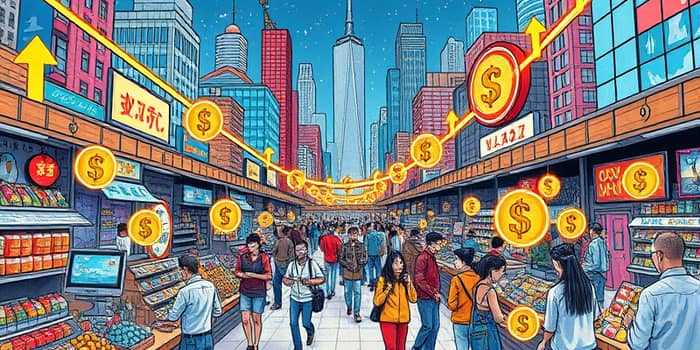
Free-market capitalism has powered some of the greatest leaps in human welfare, lifting millions out of poverty and inspiring waves of innovation.
This article explores how voluntary exchange, competition, and the rule of law combine to create a self-sustaining engine of growth.
Understanding Free Markets: The Core Thesis
At its heart, a free market operates on private property, competitive markets and voluntary exchange under a stable legal framework.
Decentralized decision-making replaces heavy bureaucracy, allowing individuals to pursue ventures without political permission.
Price signals act as invisible guides, allocating resources where they generate the greatest value and fostering continuous experimentation.
Empirical Evidence and Global Comparisons
Historical and modern data confirm that freer economies routinely outpace their controlled counterparts in growth and living standards.
In the United States, only 54% of citizens express a favorable view of capitalism, yet 95% support small businesses and 81% endorse free enterprise.
This distinction highlights a rejection of cronyism in favor of open competition and fair markets that serve consumers.
Mechanisms That Drive Prosperity
Free markets harness human creativity through choice and competition.
Without waiting for government approval, entrepreneurs respond to consumer needs, improving products and lowering costs.
- Choice and competition spark faster innovation.
- Opportunity and mobility reward industrious individuals.
- Trade and cooperation transform conflict into mutual gain.
Each transaction sends a message via price signals, coordinating dispersed knowledge better than any central plan.
Foundations for Sustained Growth
Markets flourish when supported by essential public goods and minimal interference.
- Reliable legal systems that enforce contracts.
- Quality education and infrastructure investments.
- Strong social capital built on trust and civic engagement.
Regions with permissive land-use rules, light regulation, and low taxes tend to outperform stricter jurisdictions in productivity and upward mobility.
These conditions create thick labor and idea markets where talent and innovation converge.
Challenges and Policy Directions
Public confusion often stems from conflating pure markets with crony capitalism.
Cronyism, marked by bailouts and special subsidies, undermines trust and distorts resource allocation.
Critics also cite the need for safety nets, regulation to curb moral hazards, and stabilization during downturns.
- Liberalize occupational licensing and land-use regulations.
- Promote regional integration like the Pacific Alliance model.
- Distinguish genuine market outcomes from government distortions.
By targeting reforms, policymakers can reduce barriers to entry, boost investment, and ensure markets remain vibrant and inclusive.
The Future of Markets: Innovations and Beyond
Looking ahead, free markets hold the key to solving global challenges such as climate change and energy security.
Innovation-driven growth in renewable energy, housing, and healthcare emerges fastest where entrepreneurs face fewer regulatory constraints and robust property rights.
Indices like the Heritage Foundation’s Economic Freedom rankings show that nations embracing openness achieve higher opportunity and prosperity across all social strata.
As economies evolve, the moral foundation of markets—rewarding service over status and protecting against power concentration—remains vital for sustainable peace and growth.
Ultimately, free markets are not an ideology but a mechanism: a dynamic, self-correcting system that taps into human ingenuity and mutual benefit to drive progress.
References
- https://vanceginn.substack.com/p/why-free-market-capitalism-best-supports
- https://socialsci.libretexts.org/Bookshelves/Economics/Macroeconomics/Macroeconomics_1e_(Medeiros)/02:_Supply_and_Demand/2.03:_Free_Markets__Enhanced_Growth
- https://www.heritage.org/international-economies/commentary/free-markets-limited-government-keys-prosperity
- https://www.bushcenter.org/catalyst/capitalism/clark-why-americas-free-market-economy-works-better-in-some-places-than-others/
- https://americansforprosperity.org/blog/benefits-of-a-free-market-and-how-it-can-bring-prices-down/
- https://en.wikipedia.org/wiki/Free_market
- https://fee.org/articles/the-virtues-of-the-free-economy/
- https://www.hks.harvard.edu/centers/mrcbg/programs/growthpolicy/americas-economy-and-case-free-markets
- https://www.cato.org/multimedia/events/capitalist-manifesto-why-global-free-market-will-save-world
- https://www.ebsco.com/research-starters/history/free-market
- https://freopp.org/free-market-solutions-for-climate-energy-and-prosperity/
- https://academic.oup.com/ej/article-abstract/75/300/822/5250212
- https://palmettopromise.org/principles-of-a-free-market-economy-in-south-carolina/
- https://www.philanthropyroundtable.org/resource/special-report-free-market-capitalism-and-the-path-to-flourishing/
- https://www.hoover.org/research-teams/human-prosperity-project-socialism-and-free-market-capitalism/about