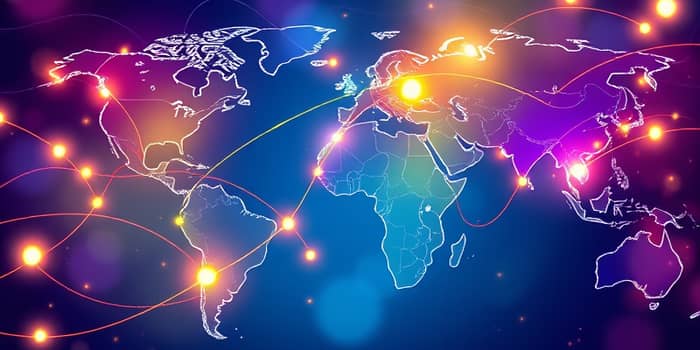
Across oceans, mountains, and deserts, a vast tapestry of commerce has emerged, binding nations in a shared economic destiny. In 2026, Asia–Europe merchandise trade eclipses $1.5 trillion annually, accounting for nearly half of all world trade. This intricate mutual dependencies and evolving dynamics reflect centuries of exchange, from the Columbian silver routes to today’s streaming data highways.
As physical goods merged with knowledge and services, the global market weave evolved into a resilient mosaic. It shines brightest where technology, policy, and culture intersect, empowering businesses, communities, and individuals to thrive across borders.
Drivers of Connection
At the heart of this global tapestry lie four core drivers: merchandise trade, foreign direct investment, human migration, and research collaborations. Europe and Asia lead with intra-regional trade four times greater than cross-regional flows, yet the ASEM network ensures a vibrant corridor linking diverse economies.
Each year, $90 billion of FDI flows between Asia and Europe, matching investment levels within Europe itself. Over 13 million migrants foster cultural exchange and labor mobility, while more than 200,000 joint research projects spark innovation. Together, these forces power rapid cross-border data flows that double annually, fueling a new era of knowledge-driven growth.
Technology as the New Loom
Digital tools now weave threads of commerce with unprecedented speed and transparency. AI and machine learning enable predictive analytics for supply chains, while blockchain ensures secure and transparent supply chains from factory floor to retail shelf. E-commerce platforms and digital payments break down barriers in emerging markets, bringing new entrepreneurs into the fold.
Growth in intangible trade—services, intellectual property, online education—has outpaced goods, demonstrating how the loom of technology transforms the cloth of globalization into a lighter, more flexible fabric.
Illustrative Case Studies
Global brands and nimble startups alike illustrate the power of this weave. Apple sources components from Asia, assembles products in multiple continents, and adapts marketing for each region. Tesla’s Gigafactory Shanghai slashes production costs and cements market share in China.
Coca-Cola tailors flavors and campaigns to local tastes, exemplifying localized marketing to diverse cultures. Meanwhile, fast-fashion giants like Shein and Temu navigate evolving tariff regimes, leveraging agile supply chains and data analytics to remain competitive.
Challenges and Risks
No tapestry is without wear. Geoeconomic fragmentation, rising tariffs, and nationalistic policies threaten to fray threads. Since 2016, protectionist measures have disrupted suppliers, while concerns over weaponized interdependence in global trade underscore the strategic leverage embedded in key nodes.
Cultural differences, regulatory divergence, and currency volatility add further tension. The narrative of deglobalization, fueled by pandemic-era supply shocks and regional conflicts, reminds us that resilience requires constant adaptation.
Strategies for Future Integration
To strengthen the global weave, stakeholders must pursue deliberate steps: rigorous market research, clear objectives, compelling value propositions, pilot initiatives, and full-scale launches. Companies and governments can embed resilience through diversification, hedging, and strategic alliances.
- Diversify partner networks via low tariffs and free trade agreements.
- Invest in digital infrastructure, workforce training, and cultural exchange programs.
- Leverage AI, blockchain, and advanced analytics to streamline operations.
By embracing local partnerships and risk management, organizations build buffers against shocks and unlock new opportunities in emerging regions.
Reimagining the Global Weave
Looking ahead, the weave will grow richer as services, data, and talent flow more freely across borders. Connector countries like Mexico and Vietnam will bridge distant markets, while digital hubs spark new collaborations. This tapestry, spun from centuries of trade and innovation, invites us to collaboratively craft a future defined by shared prosperity, resilience, and creative exchange.
In this era of interdependence, every thread matters. By weaving together technology, policy, and human ingenuity, we can transform challenges into vibrant patterns that uplift communities worldwide. The global market weave is not merely an economic construct—it is a collective masterpiece waiting for its next inspired stitch.
References
- https://www.meegle.com/en_us/topics/global-market-expansion/globalization-and-market-trends
- https://www.weforum.org/stories/2019/05/ways-asia-and-europe-together-connected/
- https://www.youtube.com/watch?v=mmqPH6UT2Lk
- https://cepr.org/voxeu/columns/connector-countries-geoeconomically-fragmented-world
- https://www.ebsco.com/research-starters/economics/technology-global-markets
- https://fl-pla.org/independent/elementary/socialScience/section4/4d2.htm
- https://www.mckinsey.com/mgi/media-center/reimagining-global-integration
- https://www.mckinsey.com/capabilities/strategy-and-corporate-finance/our-insights/global-flows-the-ties-that-bind-in-an-interconnected-world
- https://guides.loc.gov/globalization/trends-in-globalization
- https://en.wikipedia.org/wiki/Economic_interdependence
- https://spryker.com/blog/top-3-global-market-trends
- https://www.cliffsnotes.com/study-notes/24762594
- https://www.youtube.com/watch?v=PkLT4gJxHfM