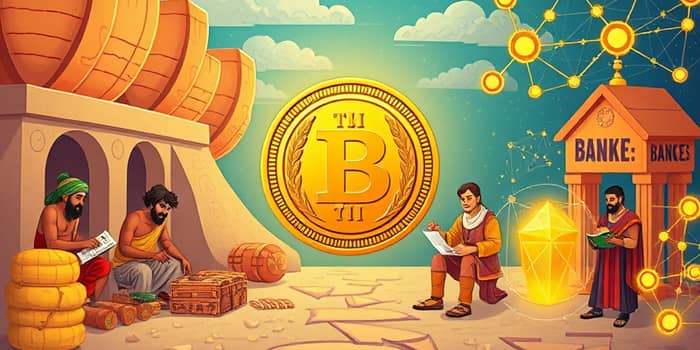
Human civilizations have always sought efficient methods to exchange goods and services. From the earliest tribal communities to the modern digital age, each innovation in exchange reflects society’s growing complexity and ingenuity.
The Barter Era: Origins of Exchange
The story of trade began around 6000 B.C., when Mesopotamian tribes formalized the exchange of commodities without money. With rising populations, simple human interactions transformed into organized barter systems to meet communal needs for food, clothing, and tools.
Barter thrived because groups specialized in different crafts: farmers cultivated grain, potters produced vessels, and weavers crafted textiles. Yet this system faced its greatest hurdle: the double coincidence of wants. Each party had to precisely want what the other offered, creating inefficiencies that stifled broader economic growth.
Common items traded in ancient times included:
- Livestock, grain, and shells
- Spices, salt, and metals
- Furs, pottery, and silks
- Deerskins and wampum
Despite its limitations, barter laid the foundation for more sophisticated systems by demonstrating the benefits of specialization and the need for trusted mediums of exchange.
The Dawn of Symbolic Value
Around 3000 B.C., Mesopotamians introduced clay tablets inscribed with agricultural symbols to record debts. This marked the first use of intrinsic versus symbolic value, where goods could be represented abstractly rather than physically exchanged.
By the Late Bronze Age, the Babylonians refined these accounting techniques, paving the way for distinct units of value. These records facilitated long-distance trade by enabling merchants to trust that debts recorded in a ledger held real-world worth.
Coin Revolution: Standardization and Trust
The 7th century B.C. witnessed a major breakthrough: the first government-issued metal coins appeared in Lydia and China. Lydian electrum coins bore a lion’s head, guaranteeing a standardized weight and purity. Simultaneously, Chinese bronze coins shaped like spades or knives circulated widely, adding portability to monetary exchange.
- Electrum coins with standardized weight
- Government issuance and backing
- Purity markings for trust
These innovations solved valuation disputes by providing a common measure of worth. Coins revolutionized commerce by enabling transactions across empires, from Phoenician sea traders to Greek city-states.
Paper Money and Portability
By 1020 A.D., the Song Dynasty in China introduced the first paper money, replacing heavy metal coins for large transactions. Paper notes carried government seals and anti-counterfeiting measures, offering lightweight, scalable monetary solutions for expanding economies.
European traders encountered these notes centuries later and recognized their potential. Paper money’s portability facilitated international trade, fueling the Renaissance’s commercial boom.
Banking and Bookkeeping Innovations
The Bank of Amsterdam, founded in 1609, pioneered modern banking by enabling deposits and withdrawals through book entries rather than physical coin exchange. Bankers verified the metal content of incoming coins and credited accounts, establishing trust in balances over bulky cash.
During the Great Depression, communities revived barter networks when currency lost value and banks failed. These networks acted as informal credit unions, demonstrating how exchange systems adapt under pressure.
Modern Monetary Systems
The 20th century saw the transition from gold-backed standards to fiat currency. Governments fiat systems depended not on intrinsic commodity value but on collective trust in central authorities. This shift required sophisticated monetary policy and regulatory frameworks to maintain stability.
Advances in electronic banking, credit cards, and online payment platforms have since streamlined daily transactions. Today, consumers tap cards or smartphones, relying on complex digital infrastructure to process trillions of dollars seamlessly.
Digital Age and Cryptocurrencies
The late 20th and early 21st centuries introduced digital currencies—starting with centralized electronic money, followed by peer-to-peer solutions. In 2009, Bitcoin emerged, proposing a decentralized peer-to-peer trust model via a distributed ledger called blockchain.
Cryptocurrencies addressed long-standing challenges: reducing reliance on intermediaries, increasing transparency, and enabling near-instant global transfers. Yet volatility and regulatory concerns remind us that every innovation carries both promise and risk.
- Peer-to-peer value consensus
- Transparent distributed ledgers
- Programmable smart contracts
Blockchain: The Future of Exchange
Blockchain technology extends beyond currencies to tokenized assets, supply chain management, and digital identity. By embedding trust into the protocol, participants can transact directly, bypassing traditional gatekeepers.
As governments and corporations explore central bank digital currencies (CBDCs) and enterprise blockchains, the lines between public and private systems blur. Innovations like banking and digital systems convergence hint at hybrid models combining regulation with decentralized guarantees.
Conclusion: Lessons for Tomorrow
The evolution from barter to blockchain underscores a single truth: exchange mechanisms evolve to solve emergent challenges. Each stage—barter, coins, paper, ledgers, and digital networks—reflects humanity’s drive to enable broader trade, build trust, and support specialization.
Looking ahead, the next frontier will likely blend human-centric governance with technological precision. Whether through digital currencies backed by central banks or decentralized autonomous organizations, the essence remains the same: facilitating fair, efficient, and trusted exchange for all.
By understanding this rich history, we gain perspective on current innovations and discover that tomorrow’s breakthroughs will rest on lessons learned since ancient Mesopotamian traders first swapped grain under clay tablets.
References
- https://primetradenw.com/history-of-the-barter-system/
- https://www.caixabankresearch.com/en/economics-markets/monetary-policy/barter-cryptocurrency-brief-history-exchange
- https://www.creditkarma.com/money/i/history-of-money
- https://wise.com/gb/blog/from-bartering-to-digital-payments-a-brief-history-of-money
- https://squareup.com/us/en/the-bottom-line/managing-your-finances/a-history-of-the-trade-and-barter-system
- https://www.youtube.com/watch?v=GZ7y-yFdX9M
- https://studentwork.prattsi.org/infovis/labs/the-emergence-of-digital-transactions-and-the-history-behind/