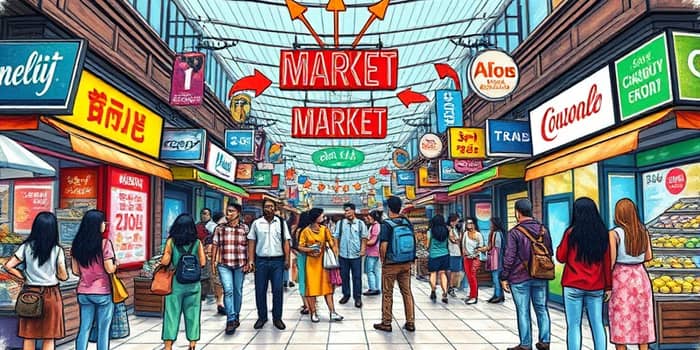
Every day, individuals face a multitude of buying decisions that shape their lives and communities. In a world of instant innovation, sprawling digital platforms, and towering conglomerates, the simple act of choosing a product has morphed into a complex journey. This article illuminates the forces at play, equips readers with insights, and offers practical steps to make empowered choices at critical market intersections.
Understanding the Landscape of Open Markets
Open markets promise abundance: an endless parade of products, services, and experiences. In theory, price is determined by supply and demand, with consumers free to compare, switch, and decide. Yet real markets rarely mirror the ideal of perfect competition. They are shaped by powerful firms, regulatory twists, and information gaps that color every transaction.
Under a perfect competition model, many small buyers and sellers exchange identical goods without barriers. In practice, market power concentrates, search costs mount, and legal constraints—tariffs, licensing, standards—skew available options. When these deviations occur, consumer choice at the crossroads becomes less transparent and more constrained by hidden forces.
The Illusion of Choice Amidst Concentration
Despite the veneer of variety, many sectors have shrunk to a handful of dominant players. From retail giants to media conglomerates, consolidation shapes which goods reach store shelves and screens. Amazon and Walmart may offer endless selections today, but their expansion often drives independent shops and niche brands into extinction. Over time, fewer genuinely distinct product options remain, even when dozens of labels appear.
Behind each merger and acquisition lies a trade-off: short-term price relief versus long-term narrowing of options. When a single conglomerate owns multiple “competing” brands, loyalty programs and bundled ecosystems can lock consumers into proprietary platforms, restricting genuine autonomy despite the appearance of choice.
Behavioral Crossroads: When Too Many Options Paralyze
More options do not always translate into better outcomes. Psychological research reveals that an overload of choices can overwhelm, causing decision fatigue and regret. Standard economic models falter when human biases steer behavior. Consider:
- Losses loom larger than gains: People fear giving up what they have more than they value equivalent gains.
- Status quo bias: Choosing the default or familiar option even when superior alternatives exist.
- Choice overload: Too many products can reduce satisfaction and stall decisions entirely.
At critical junctures—whether selecting an energy plan, picking a grocery brand, or choosing a subscription service—consumers face friction that echoes long after the purchase is made. Understanding these biases helps individuals craft strategies to simplify decisions and resist manipulative framing techniques.
Economic Pressures at the Consumer Crossroads
Today’s markets intersect with macro challenges: inflation, stagnant real wages, debt burdens, and interest rate fluctuations. Surveys show households feel squeezed even as aggregate indicators modestly improve. When inflation erodes purchasing power swiftly, every choice demands reevaluation of priorities between immediate needs and long-term resilience.
Wage growth has lagged price increases, forcing many families to allocate larger shares of income to essentials like housing and utilities. Equifax analysts estimate households must stretch budgets by roughly $2,400 annually just to maintain basic living standards. Meanwhile, credit use hovers near record highs, and tighter lending standards raise barriers for new loans.
These conditions create a financial crossroads: spend on groceries or service debt? Upgrade to renewable energy rates or stick with a standard plan? Invest in homeownership or continue renting to preserve liquidity? Each consumer’s path depends not only on market offerings but on individual circumstances and risk tolerance.
Strategies for Navigating Open Markets
Empowerment begins with informed action. Consumers can adopt tangible practices to regain control:
- Establish clear priorities: focus on products that align with budget constraints, personal values, and long-term goals.
- Leverage comparison tools: use independent review sites, standardized labels, and trusted community recommendations.
- Embrace minimalism: reduce clutter by selecting fewer, higher-quality items that deliver long-lasting value.
- Build support networks: share experiences with peers, join co-ops or buying groups, and tap local expertise.
By consciously designing decision frameworks—such as setting spending limits, scheduling research time, or pre-committing to ethical criteria—individuals can defuse choice fatigue and circumvent predatory marketing tactics.
Looking Ahead: Empowering Consumer Choice
Realizing genuine choice in open markets requires coordinated efforts beyond individual action. Policy reforms to strengthen antitrust enforcement, enforce transparent labeling, and standardize plan comparisons can dismantle hidden barriers. Platforms and regulators must collaborate to ensure that digital interfaces present clear, comparable information free of manipulative defaults.
Educators and civil society have a role to play in enhancing digital and financial literacy for all ages. When consumers understand market mechanisms, they can spot opaque pricing, identify conflicts of interest, and demand accountability from powerful firms.
The journey through consumer crossroads is not merely transactional—it reflects broader values about autonomy, sustainability, and community well-being. As markets evolve with AI, renewable energy, and novel business models, consumers who cultivate critical awareness and organized habits will shape a future where choice truly empowers every individual.
References
- https://blog.grow-za.com/navigating-business-crossroads-recognising-responding-critical-turning-points
- https://www.openmarketsinstitute.org/learn/consumer-choice-monopoly
- https://www.emerald.com/eemcs/article/1316119/PinkCart-s-crossroads-navigating-market-entry-and
- https://www.imf.org/en/publications/fandd/issues/series/back-to-basics/supply-and-demand
- https://www.equifax.com/newsroom/all-news/-/story/navigating-economic-crossroads-insights-from-market-pulse-webinar/
- https://www.cambridge.org/core/books/inexact-and-separate-science-of-economics/demand-and-consumer-choice/F70A528039DDB5BBC3C740B54E70C1FA
- https://www.aaea.org/publications/publications-update/us-agricultural-trade-at-a-crossroads-navigating-protectionism-global-competition-and-economic-integration
- https://digitalcommons.chapman.edu/business_articles/32/
- https://www.hinshawlaw.com/en/insights/blogs/consumer-crossroads-where-financial-services-and-litigation-intersect?bc=492
- https://www.sba.gov/business-guide/plan-your-business/market-research-competitive-analysis
- https://journals.sagepub.com/doi/abs/10.1509/jmkr.48.2.255
- https://ankura.com/insights/navigating-the-economic-crossroads-u-s-growth-amidst-rising-consumer-concerns
- https://www.intechopen.com/welcome/1005563