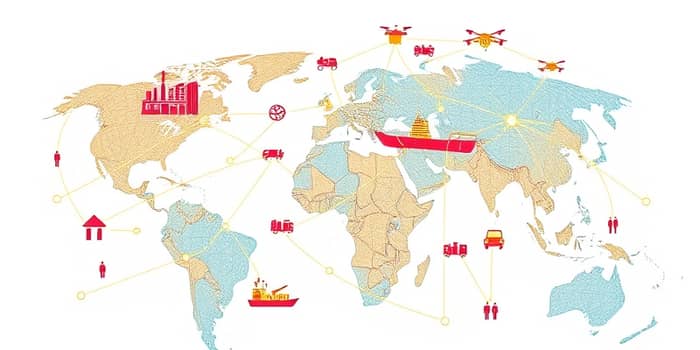
In today’s interconnected world, traditional supply chains have evolved into living, breathing ecosystems that respond dynamically to demand, disruptions, and innovation. Companies and communities alike stand to benefit when they understand how to design and manage these networked systems.
The Evolution to Networked Ecosystems
Supply chains once operated as linear, siloed constructs, where materials moved from point A to point B in predictable steps. Now, they form integrated systems that adapt in real time, driven by customer expectations and global challenges.
By embracing a citizen-centric perspective on logistics, businesses place societal needs at the heart of every decision. This shift unlocks new opportunities for collaboration across industries—banking, healthcare, energy, logistics—and transforms how goods and services reach end users.
Four Essential Flows
At the core of any networked supply ecosystem lie four interdependent flows. Understanding each is key to achieving unprecedented levels of end-to-end visibility:
- Material flows: movement of raw materials through to finished products
- Information flows: seamless exchange of data and information among partners
- Financial flows: timely transfers of funds enabling production and delivery
- Human flows: talent mobility that drives innovation and operational excellence
Powering the Future with Technology
Modern networks leverage cutting-edge digital tools to create agile ecosystems capable of rapid response. Key enablers include:
- Internet of Things for real-time monitoring of shipments, temperature, and container conditions
- AI and machine learning for route optimization, demand forecasting, and risk identification
- Cloud platforms and distributed ledgers offering trusted, secure data access
- Automation—from autonomous drones to robotic warehouses—speeding up deliveries and reducing errors
Organizations that integrate these technologies gain dynamic, collaborative supply networks capable of anticipating disruptions and seizing new opportunities.
Building Sustainable and Resilient Networks
Sustainability and resilience go hand in hand. Decarbonization efforts—such as adopting alternative fuels, optimizing vehicle loads, and redesigning products for circularity—reduce environmental impact while boosting brand value.
Resilient networks rely on predict and mitigate global disruptions. Strategies include friend-shoring, reshoring critical operations, and forging strong partnerships with third-party logistics providers to secure shared data and visibility.
Driving Economic and Operational Impact
Investments in networked supply chains deliver concrete business benefits. Companies report:
- Revenue growth of 5–20% from sustainable initiatives
- Cost reductions of 9–16% through optimized routing and inventory management
- Brand value increases up to 30% by demonstrating environmental stewardship
By applying strategies like SKU rationalization, strategic sourcing, and spend analytics, businesses can extract cash flow benefits while maintaining a commitment to sustainability.
Embracing Real-Time and Multi-Tier Visibility
True transformation occurs when networks operate in real time. IoT and M2M communications fuel unified, cross-industry collaboration, enabling companies to sense, analyze, produce, deliver, monitor, and operate with full transparency.
Advanced platforms provide multi-tier visibility, spotlighting bottlenecks and triggering automated workflows. Collaborative allocation tools ensure scarce materials reach high-value orders, while smart rerouting limits disruptions in transit.
Charting a Course Beyond Traditional Supply Chains
The journey toward networked supply chains is both a challenge and an opportunity. Leaders who champion integrated ecosystems, harness advanced technologies, and foster collaborative partnerships will redefine how goods and services flow around the world.
By viewing supply chains as living networks rather than linear pipelines, organizations can achieve holistic view of every process stage, anticipate changes, and deliver value sustainably and resiliently.
Embrace this new paradigm. Transform your logistics into a vibrant, responsive network that not only meets today’s demands but anticipates tomorrow’s possibilities.
References
- https://www.ey.com/en_us/coo/a-networked-supply-chain-helps-coos-counter-disruption
- https://www.productperfect.com/blog/modern-logistics-how-breakthroughs-in-network-connectivity-will-change-the-world
- https://www.cgi.com/en/podcast/energy-utilities/beyond-borders-rise-citizen-supply-chain-connected-economy
- https://www.weforum.org/stories/2015/01/how-the-network-economy-is-revolutionizing-supply-chains/
- https://www.techfinitive.com/features/what-is-a-modern-network-anyway/
- https://www.e2open.com/blog/why-modern-supply-chains-need-supply-chain-networks
- https://www.hfsresearch.com/research/five-steps-to-an-autonomous/
- https://www.prove.com/blog/understanding-modern-networks-business-models-examples
- https://blueyonder.com/solutions/supply-chain-command-center
- https://www.vectra.ai/topics/modern-network
- https://platformthinkinglabs.com/materials/the-future-of-supply-chains-as-networked-ecosystems/
- https://www.accenture.com/us-en/insights/cloud/modern-network
- https://aws.amazon.com/blogs/networking-and-content-delivery/network-observability-for-modern-applications/