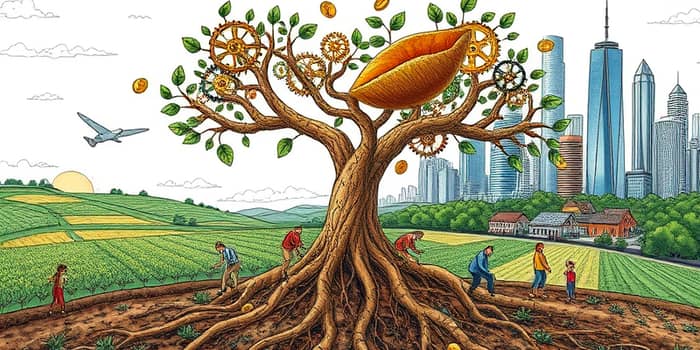
Every great economic transformation begins with a single act of saving, a metaphorical seed sown in fertile ground. From this modest beginning, capital embarks on an epic voyage through allocation, production, and eventual distribution.
By tracing capital’s lifecycle at both firm and national levels, we uncover how societies harness resources to generate prosperity.
The Seed of Savings: Origin of Capital
At its core, capital starts as deferred consumption. Households choose to forgo immediate spending, creating a pool of funds that can be deployed into productive ventures.
These initial resources include:
- Household savings and foregone consumption that accumulate over time.
- Friends, family, and seed capital programs offering early-stage equity.
- Angel investors and government incentives like tax credits, which lower the risk for early investors.
Time preference theory explains why savers demand compensation: capital must be rewarded to justify postponing consumption.
Allocation and Germination: Due Diligence and Discipline
Once seeds of capital exist, they must be allocated efficiently. Financial intermediaries—banks, venture funds, and development agencies—play a critical role in screening opportunities and managing risk.
The due diligence process uncovers hidden challenges and aligns incentives between savers and entrepreneurs. When quality information emerges, capital flows where it can generate the highest returns; when uncertainty prevails, funds remain idle or redeployed.
This stage highlights the fundamental role of asymmetric information and underscores why robust governance and transparency matter.
Growth Stage: Transforming Funds into Productive Assets
Capital morphs into tangible and intangible assets that drive output. Firms allocate funds to:
- Physical capital such as machinery, buildings, and equipment.
- Intangible assets: software, patents, branding, and organizational know-how.
- Human capital and infrastructure investments in education and health.
As capital per worker increases, labor productivity rises—a phenomenon known as capital deepening. Firms apply rigorous capital budgeting methods, evaluating projected cash flows to decide whether to proceed. Depreciation and replacement cycles also factor into net investment calculations.
Harvest at the Firm Level: Profits and Exits
The first tangible reward of investment appears as profits, dividends, or share repurchases. Private equity and venture capital investors often seek exits via IPOs or acquisitions, converting paper gains into liquidity.
This economic harvest of profits and wages fuels further consumption and reinvestment, completing a virtuous cycle where seeds planted today contribute to future growth opportunities.
Mapping National Development: Rostow’s Five Stages
The journey of a single dollar mirrors the collective trajectory of nations ascending through Rostow’s framework. Each stage reflects evolving capital endowments, institutional quality, and technological capabilities.
Through these phases, economies transition from factor accumulation to innovation-driven growth, supported by robust institutions and legal frameworks.
Mechanisms of Harvest: From Capital to Wellbeing
Turning capital into widespread prosperity involves several mechanisms:
- Efficient financial intermediaries and institutions that channel savings to productive projects.
- Regulatory frameworks that protect property rights and enforce contracts.
- Technological diffusion unlocking the transformative power of technology across industries.
When these elements interact seamlessly, the gains from investment translate into higher wages, corporate profits, and tax revenues that fund public goods.
Contemporary Innovations: VC, Impact Investing, and Regeneration
The modern landscape of capital allocation includes venture capital, impact investing, and regenerative finance. These paradigms expand the traditional profit motive to encompass social and environmental outcomes.
Impact funds measure success by both financial returns and metrics like carbon sequestration or social inclusion. Regenerative agriculture projects demonstrate how capital can restore ecosystems while generating sustainable yields.
Such innovations reflect a broader understanding that capital’s journey is not complete until it fosters resilience and shared prosperity.
Tensions and Critiques: Navigating Complexities
Despite its promise, the capital journey faces critiques. High savings rates can crowd out consumption, while unchecked investment booms may spark asset bubbles.
In developing economies, weak banking systems and governance failures can obstruct capital flows, leading to persistent underinvestment. Meanwhile, global capital mobility introduces volatility, as sudden inflows or outflows exacerbate financial instability.
A thoughtful policy balance—combining prudent regulation, targeted subsidies, and institutional reforms—ensures that capital remains a force for sustainable growth rather than a source of disruption.
Ultimately, the narrative of capital’s journey—from humble savings to a bountiful economic harvest—remains central to understanding how societies generate wealth, improve living standards, and secure a shared future of innovation and progress.
References
- https://mn.gov/deed/business/financing-business/tax-credits/seed-capital/
- https://www.scribd.com/document/458759140/5-phases-of-economic-development-docx
- https://www.farm-equipment.com/articles/16852-clean-seed-capital-group-backs-away-from-harvest-international-acquisition
- https://www.policyarena.org/p/rostows-the-stages-of-growth-needs
- https://seedtoharvest.buzzsprout.com
- https://media.lanecc.edu/users/martinezp/204/DevtTheories.html
- https://podcasts.apple.com/us/podcast/seed-to-harvest/id1600933931
- https://www.youtube.com/watch?v=t-HQ_YLvnCw
- https://www.youtube.com/playlist?list=PLqaAwY_mpiU66QahTY-njEChs_WXEvlXw
- https://www.minneapolisfed.org/article/2016/the-stages-of-economic-growth-revisited
- https://www.youtube.com/watch?v=u5pF2jzChp8