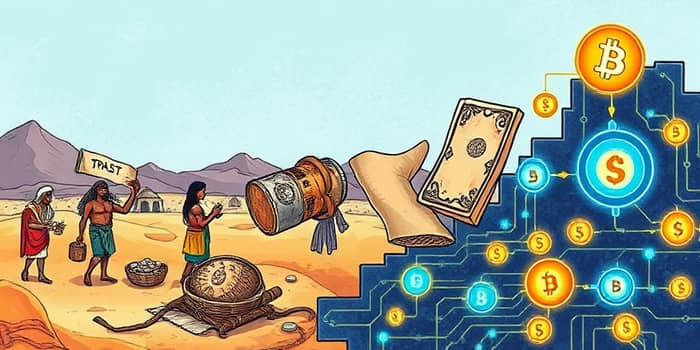
From the bustling markets of Mesopotamia to the invisible ledgers of blockchain, the journey of exchange reveals the resilient spirit of humanity. By understanding the steps from barter to digital money, we can harness trust and creativity to craft the next evolutionary leap forward. This article traces key innovations, highlights enduring social challenges, and offers actionable insights for innovators, entrepreneurs, and community builders eager to foster transparent, inclusive, and efficient systems of value transfer.
The Barter Era: Foundations of Trust and Exchange
At its core, the barter system was more than a means to obtain goods—it embodied community bonds and faith in one another. Archaeological finds place the first barter transactions in Mesopotamia around 6000 BC, with Phoenician traders later extending routes across the Nile. Farmers exchanged grain for tools, while artisans bartered pottery for textiles.
Yet, this system carried the inherent challenge known as the double coincidence of wants: both parties needed precisely what the other offered. As populations grew and settlements spread, this friction slowed commerce. Even in 19th-century Britain and America, Owenite socialists attempted to revitalize barter with labour notes, highlighting barter’s deep roots in communal trust.
Commodity Money: Solving the Double Coincidence Problem
To overcome barter’s limitations, societies adopted objects with intrinsic or widely recognized value. Shells, salt, and metals became early currency—each carrying weight, rarity, or cultural significance that all parties accepted.
- Cowrie shells used across Africa and Asia
- Salt bars traded in Mediterranean bazaars
- Gold and silver ingots in Mesopotamia and Egypt
- Bronze-age ax heads and knives as portable wealth
By providing a uniform measure of value, commodity money simplified transactions and enabled merchants to venture farther. Cargoes of metal could be weighed once and exchanged multiple times, reducing haggling and building wider trading networks.
Coinage and Standardization: Building Robust Markets
The Lydians of Asia Minor pioneered stamped coins in the 7th century BC, forging a revolution. Each coin bore a trusted seal, guaranteeing weight and purity. Greek city-states swiftly adopted the practice and propelled coins across the Mediterranean.
Standardized tokens replaced lengthy weighing rituals, giving rise to professional merchants, urban markets, and even military paymasters. During the Renaissance, the cylinder press further mechanized coin production, thwarting counterfeiters and cementing the principle of standardized coinage across empires.
Paper Money: The Dawn of Representative Value
As long-distance trade flourished, lugging heavy metal became impractical. In medieval China, merchants deposited gold with trusted institutions and received paper notes—a leap to intrinsic to representative value. Weeks or months later, notes could be redeemed for metal, ensuring fidelity.
Eight centuries later, the Bank of England issued Europe’s first viable paper currency, easing commerce across the British Isles. The 1830s also saw experiments in labour notes by social reformers seeking to align work time with value, underscoring humanity’s ongoing quest for equitable exchange.
Electronic and Digital Money: Transactions without Borders
The late 20th century marked the shift from tangible to virtual currency. Electronic banking systems enabled instantaneous fund transfers, and platforms like PayPal bridged continents at the click of a button. Today, blockchain and cryptocurrency experiments push boundaries further.
Digital money removes the friction of physical cash: no counting, no transport, no wear. Yet the essential challenge remains social—establishing trust in code and consensus protocols. By blending innovation with governance, we aim to achieve unbridled technological progress and innovation without sacrificing security or inclusion.
Embracing the Future: Lessons and Practical Guidance
As we stand at the cusp of new financial frontiers, history offers vital lessons:
- Build trust through transparency and accountability
- Standardize protocols before scaling systems
- Maintain adaptability to embrace emergent needs
- Balance innovation with equitable access
- Invest in education to nurture informed communities
By weaving these principles into design and policy, innovators can foster sustainable economic growth and prosperity while bridging communities through trade. Whether designing a local time-bank, launching a new digital wallet, or shaping regulatory frameworks, remembering our shared past grounds us in collective wisdom.
The arc of exchange shows that every system—no matter how advanced—relies on social agreement and trust. As technology evolves, so too must our commitment to inclusion, transparency, and cooperative progress. In moving beyond barter, we carry forward a legacy of ingenuity, connecting hands, ideas, and dreams across time and space.
References
- https://sociology.institute/economic-sociology/evolution-exchange-systems-history/
- https://study.com/academy/lesson/bartering-systems-definition-lesson-quiz.html
- https://squareup.com/us/en/the-bottom-line/managing-your-finances/a-history-of-the-trade-and-barter-system
- https://www.hiro.so/blog/tracing-the-social-narratives-shaping-the-future-of-money-bartering-to-banknotes-to-bitcoin
- https://en.wikipedia.org/wiki/Barter
- https://www.transwap.com/blog/the-history-of-foreign-exchange-part-1
- https://socialvps.net/the-history-of-trading-from-barter-to-modern-markets/
- https://www.caixabankresearch.com/en/economics-markets/monetary-policy/barter-cryptocurrency-brief-history-exchange
- https://sproutsschools.com/the-history-of-money-barter-fiat-and-bitcoin/
- https://www.rcibank.co.uk/node/600
- https://www.youtube.com/watch?v=O5Xyov8HDBI