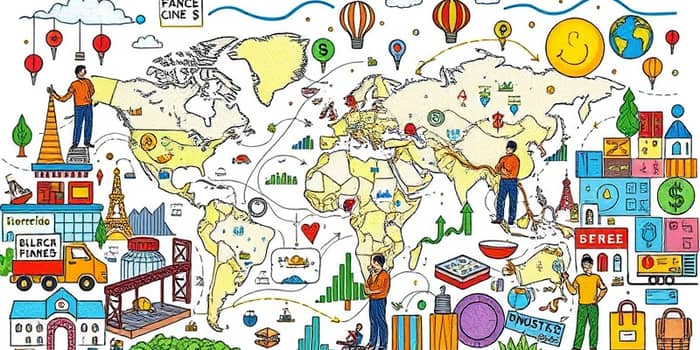
In an era defined by rapid technological breakthroughs, geopolitical tensions, and environmental uncertainty, the concept of an adaptive economy has surged to the forefront of scholarly debate and practical policy. No longer is stability the ultimate goal; instead, the most successful economies are those that treat uncertainty as a constant and harness disruption as an engine of progress.
This article explores how markets evolve like living ecosystems, examines empirical evidence from emerging regions, and offers strategies for individuals, businesses, and policymakers to flourish amid perpetual change.
Understanding Adaptive Economies
At its core, an adaptive economy is one where agents—households, firms, investors, and governments—continuously update their strategies in response to shifting technological, environmental, and financial landscapes. Drawing on principles from the Adaptive Market Hypothesis, resilience frameworks, and adaptive economics, these systems do not merely survive shocks—they transform and emerge stronger.
- Treats feedback loops and data as foundational inputs for decision making.
- Prioritizes flexibility, diversification, and learning over fixed optimization.
- Embraces market mechanisms, policy frameworks, and social behavior in concert.
- Considers uncertainty a permanent feature, not an anomaly.
Such economies are designed to exploit shocks for long-term gains, scaling innovation when circumstances demand and reallocating resources in real time.
Markets as Evolving Ecosystems
The Adaptive Market Hypothesis (AMH), pioneered by Andrew W. Lo, reframes financial markets as ecosystems governed by competition, adaptation, and natural selection. It bridges the Efficient Market Hypothesis—which posits that prices fully reflect available information—and behavioral finance, which highlights human biases and heuristics.
Under AMH, market efficiency becomes context-dependent and time-varying: it hinges on the number of participants, profit opportunities, and the adaptability of each “species” in the economy, from retail investors to high-frequency traders. Strategies that flourish in one regime may collapse when conditions shift, underscoring the need for continuous learning and evolution.
Empirical evidence from a 15-year study of nine MENA markets demonstrates significant regime switching between efficient and inefficient states. Researchers used Markov Switching Models to detect those shifts, momentum strategies to exploit temporary arbitrage, and LSTM neural networks—conditioned on regime states—to enhance predictive accuracy. The findings confirm that market predictability is regime-dependent, validating the AMH view that no single strategy remains superior indefinitely.
Navigating Global Instabilities
Today’s “new normal” is one of perpetual flux. Geopolitical conflicts, shifting trade policies, technological disruption, and climate risk have dismantled assumptions of steady globalization and low interest rates.
- Supply chain restructuring: Transitioning from hyper-efficient, single-region sourcing to diversified, regional networks to reduce concentration risk.
- Evolving investment strategies: Emphasizing risk management, cross-asset diversification, and long-term fundamentals over short-term momentum.
- Advanced technology deployment: Employing AI, real-time analytics, and scenario planning to adjust pricing, inventory, and allocations on the fly.
- Redefining resilience: Measuring success by the capacity to evolve rather than resist change.
These adaptations reflect a broader shift: resilience is now synonymous with continuous evolution, not mere resistance to shocks.
Empowering Individuals and Communities
Economic Adaptation (EA) extends the adaptive economy paradigm to individual and community levels. It acknowledges that change and complexity are permanent, urging people to develop mindsets, tools, and strategies that turn uncertainty into opportunity.
- Continuous learning and skill development: Cultivating versatile competencies, from digital literacy to cross-cultural collaboration.
- Financial flexibility: Maintaining diversified savings, multiple income streams, and agile budgeting practices.
- Community networks: Building local alliances for resource sharing, mutual aid, and cooperative innovation.
- Scenario planning and foresight: Regularly stress-testing personal and community plans against varied economic and environmental scenarios.
- Embracing experimentation: Piloting new business models, digital platforms, or local currencies to discover resilient solutions.
By internalizing uncertainty as a permanent characteristic of modern economies, individuals and communities become co-architects of adaptation rather than passive reactors.
Charting the Path Forward
Adaptive economies thrive on three pillars: proactive policy frameworks, adaptive business models, and empowered citizens. Policymakers should implement flexible regulations and dynamic incentives that adjust to real-time feedback. Corporations must integrate agile processes, robust scenario planning, and continuous learning cultures. Communities and individuals should prioritize diversification, collaboration, and experimentation.
The future belongs to those who treat change not as a threat but as the raw material of innovation. By weaving adaptability into every layer of economic activity—from global markets to neighborhood initiatives—we can craft systems that not only endure but flourish in shifting landscapes.
As we confront climate extremes, technological revolutions, and geopolitical uncertainties, let us embrace an adaptive ethos: learn constantly, iterate boldly, and transform challenges into stepping stones toward sustainable prosperity.
References
- https://journals.ekb.eg/article_441886.html
- https://gca.org/resilienteconomiesindex/
- https://kendi.framer.media/blog/how-global-markets-are-adapting-to-a-new-era-of-economic-uncertainty
- https://www.climatepolicyinitiative.org/publication/state-and-trends-of-climate-adaptation-finance-in-small-island-developing-states/
- https://en.wikipedia.org/wiki/Adaptive_market_hypothesis
- https://www.oecd.org/en/publications/scaling-up-adaptation-finance-in-developing-countries_b0878862-en.html
- https://www.youtube.com/watch?v=qxZsK7bexjw
- https://www.financialhealthinstitute.org/blog/navigating-chaos-why-economic-adaptation-matters-more-than-ever
- https://evonomics.com/it-takes-a-theory-to-beat-a-theory-andrew-lo/
- https://www.cambridge.org/core/books/divergent-dynamics-of-economic-growth/global-trends-and-adaptive-economics/72B85A513B88B1190871135F4D92FF5E
- https://www.youtube.com/watch?v=UUIZNyE12K8