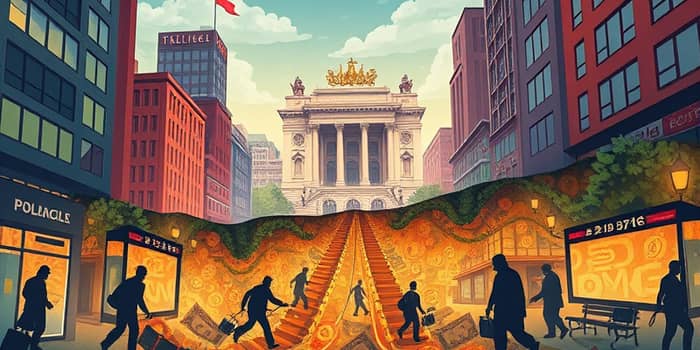
The shadow economy shapes the lives of billions around the world, often operating just out of sight of official oversight. By understanding its scale, drivers, and consequences, we can empower communities and policymakers to foster a more inclusive and transparent economic future.
Understanding the Shadow Economy
The shadow economy, also called the underground or informal economy, encompasses all productive activities not officially recognized by governments. From unreported cash transactions to illicit enterprises, these hidden markets generate vast sums outside the tax net.
Experts estimate that the shadow economy amounts to trillions in unseen revenue each year, equivalent to roughly 11.8% of global GDP or about $12.5 trillion. While some activities—like small-scale street vending—are nonviolent and community-based, others can involve serious criminality, such as drug trafficking or human smuggling.
Global Scope and Regional Patterns
Over the past two decades, the size of the shadow economy has shifted significantly. In 2000, it represented an average of 17.7% of world GDP, declining to 11.8% by 2023. This downward trend was observed in 119 of 131 analyzed countries, reflecting improved enforcement and economic conditions.
However, vast regional differences remain. Low-income nations often rely on large informal sectors—up to 42.4% of GDP—while high-income economies typically see rates below 6%. For many developing countries, informal markets provide critical employment and livelihood opportunities, despite operating outside regulatory frameworks.
Notably, Sierra Leone, Niger, and Nepal each see over half their economic activities take place informally, whereas the UAE maintains one of the smallest levels globally at 2.1% of GDP.
What Fuels Hidden Markets
- High Tax Burdens: Steep personal and corporate taxes incentivize tax evasion and off-the-books transactions.
- Stringent Labor Regulations: Overly rigid hiring rules drive businesses to hire workers informally.
- Poor Public Services: When health, education, and infrastructure are subpar, individuals seek informal alternatives.
- Stagnant Official Economy: Slow growth or high unemployment pushes more participants underground.
Consequences Beyond Numbers
While informal activities may offer short-term solutions for workers and entrepreneurs, they carry far-reaching economic and social consequences. For governments, uncollected taxes widen the fiscal gap and reduce funding for essential services.
Businesses operating legally face an uneven playing field; competing against untaxed rivals undermines fair and lawful competition and discourages investment. Communities can also suffer when illicit networks finance violence or corruption, eroding trust in public institutions.
Charting a Path Forward
Although the shadow economy presents formidable challenges, evidence-based policies can gradually bring hidden activities into the formal sector. Key strategies include:
- Enhanced Administrative Transparency: Simplify registration and reporting to foster greater trust in institutions and reduce compliance costs.
- Business Formalization Incentives: Offer tax breaks, microfinance, or training to help entrepreneurs formalize their operations for lasting benefits.
- Technology and Data Analytics: Deploy digital tax-filing systems and leveraging advanced data analytics tools to detect irregularities without burdening honest taxpayers.
- International Cooperation: Share intelligence and best practices across borders to curb transnational hidden trade and money laundering.
- Community Engagement: Educate citizens about the social cost of informal economies and encourage local reporting of illicit activities.
Looking Ahead: Future Prospects
Projections suggest that by 2025, the global shadow economy could shrink further, thanks to technological advances, improved governance, and coordinated international efforts. Yet, not all regions will witness the same decline; emerging economies facing political instability may see informal sectors grow in response to inadequate public services.
The journey toward a more transparent economy requires collaboration among governments, businesses, and civil society. By balancing enforcement with support for small entrepreneurs, communities can maintain the vitality of informal markets while ensuring a fair and stable economic environment.
Conclusion
Understanding the hidden currents of the shadow economy is the first step in addressing its challenges. With targeted policies and collective resolve, we can transform unseen forces into engines of growth and opportunity.
By shining a light on informal markets, we pave the way for stronger public finances, healthier competition, and inclusive prosperity. The task is complex, but by embracing innovative solutions and fostering trust at every level, we can build an economic landscape where all participants thrive under the same rules and protections.
References
- https://www.accaglobal.com/us/en/technical-activities/technical-resources-search/2017/june/emerging-from-the-shadows-the-shadow-economy-to-2025.html
- https://openknowledge.worldbank.org/entities/publication/256e1cbc-c288-591f-a6ac-91d8338196b3
- https://www.visualcapitalist.com/size-of-the-shadow-economy-by-country/
- https://www.visualcapitalist.com/the-worlds-biggest-shadow-economies/
- https://www.visualcapitalist.com/worlds-12-5-trillion-underground-economy/
- https://www.imf.org/en/Publications/WEO/Issues/2025/04/22/world-economic-outlook-april-2025
- https://www.integrin.dk/2025/05/21/shadow-economy-in-europe-and-the-world/
- https://www.voronoiapp.com/crime/Visualizing-the-Worlds-Shadow-Economies--5018
- https://www.ey.com/en_dk/insights/tax/why-the-shadow-economy-persists-and-how-governments-are-responding
- https://www.worldeconomics.com/Informal-Economy/