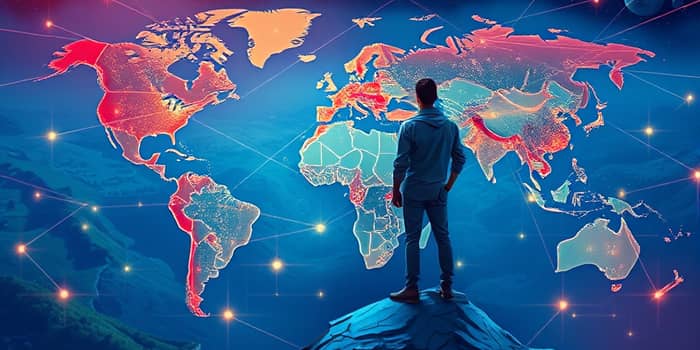
In a world of rapid technological change and shifting economic landscapes, seized opportunities can separate the visionary from the forgotten. This article explores how entrepreneurs can harness innovation and emerging markets to carve a lasting competitive advantage.
The Power of Technological Pioneering
At its heart, technological pioneering means creating and successfully commercializing breakthroughs that redefine industries. Companies that lead with fresh inventions can shape customer expectations, set industry standards, and access resources before competitors arrive.
Yet being first carries inherent risks. First movers face steep research and development outlays, the challenge of educating customers, and the possibility of being overtaken by faster followers who refine or adapt the original idea.
- early access to scarce resources: securing key partners, suppliers, or distribution channels before they become congested.
- learning curve advantages and cost reductions: refining processes over time to lower production expenses and improve quality.
- higher uncertainty and education costs: investing heavily to demonstrate value and overcome customer skepticism.
- risk of being leapfrogged by followers: later entrants may improve on original designs or capitalize on market feedback.
Conditions for Successful Pioneering
To convert bold invention into lasting leadership, entrepreneurs must pair vision with discipline. Five critical enablers distinguish triumph from folly:
- careful planning and strategic clarity: defining target segments, value propositions, and resource needs before launch.
- managerial resourcefulness in uncertainty: orchestrating capital, talent, and partnerships even when outcomes are unclear.
- fast iteration and experimentation structures: fostering cross-functional teams that learn quickly and adjust their approach.
- educate the market and reduce barriers: aligning technology with real customer needs and simplifying adoption.
- timing aligned with market maturity: entering when infrastructure, regulation, and complementary assets are ready.
Emerging Markets: The Expanding Opportunity
Global growth is shifting toward developing economies. The world population recently exceeded 8 billion, with two-thirds living in EMDEs (emerging market and developing economies). By 2050, this share will climb toward 86%, and Africa’s working-age cohort alone will swell by 450 million by 2030.
Emerging markets now drive two-thirds of global GDP growth. In 2024, EMDEs are projected to expand by 4.1%, compared to just 1.5% in advanced economies. Leading regions include:
Rapid digitalization, rising internet penetration, and a youthful population create fertile ground for fintech, e-commerce, and digital services. Entrepreneurs who tap into these trends can serve young, digitally adept consumers and address unmet needs in financial inclusion, logistics, and online commerce.
Frontier Markets: High Risk, High Reward
Frontier markets are a subset of EMDEs with smaller size, lower liquidity, and partial financial integration. Although they account for only 5% of global output, they host one-fifth of the world’s population and are expected to drive much of its future growth.
Many frontier economies boast natural resources, rising physical capital, and improving institutions. Yet they also face challenges: volatile capital flows, slower poverty reduction, and underdeveloped infrastructure.
Entrepreneurs assessing frontier opportunities must weigh abundant upside against structural vulnerabilities. Success often hinges on forging strong local partnerships, understanding regulatory landscapes, and building resilience against market swings.
Strategies for Entrepreneurs Venturing Into New Frontiers
Translating insight into action demands a blend of research, adaptability, and strategic execution. Consider these five guiding practices:
- rigorous due diligence and partnerships: collaborate with local experts to navigate regulations and build trust.
- adaptation to local cultures and regulations: customize products, pricing, and messaging to fit local norms.
- local payment method integration: embed mobile money, wallets, and bank transfers preferred by consumers.
- leveraging digital channels and analytics: track user behavior, optimize acquisition, and scale successful tactics rapidly.
- building scalable supply chains: invest in logistics and distribution networks that grow with demand.
By combining dynamic capabilities: sensing and seizing opportunities with a deep understanding of local ecosystems, entrepreneurs can navigate complexity and capture new growth. Digital pilots, micro-partnerships, and iterative rollouts help mitigate risk while refining the value proposition.
Conclusion: Seizing the Entrepreneurial Edge
Pioneering new market frontiers is an adventure that rewards those who balance bold innovation with disciplined execution. Entrepreneurs who master scaling with cultural sensitivity and agility will not only secure first-mover advantages but also build the foundations for enduring success.
As global demographics and technologies reshape where and how value is created, the greatest rewards will go to those who combine vision, resourcefulness, and local insight. Embrace the challenge, plan with precision, and step boldly into the markets of tomorrow.
References
- https://journals.aom.org/doi/10.5465/ame.1995.9503133481
- https://merchantriskcouncil.org/learning/resource-center/member-news/blog/2024/why-emerging-markets-are-the-next-frontier-for-global-business-expansion
- https://www.chiefoutsiders.com/blog/the-brave-new-world-of-new-markets-five-steps-to-conquering-new-business-frontiers
- https://www.blackrock.com/uk/solutions/investment-trusts/our-range/blackrock-frontiers-investment-trust/trust-information/insights/why-frontier-markets-play-a-role-in-global-trends
- https://activation.capital/?p=7790
- https://www.morganstanley.com/insights/articles/private-companies-reshaping-global-markets
- https://www.strategy-business.com/article/18881
- https://www.worldbank.org/en/research/publication/frontier-markets
- https://pmc.ncbi.nlm.nih.gov/articles/PMC9650035/
- https://www.youtube.com/watch?v=8ZqHEkwxQxo
- https://www.msci.com/indexes/index-resources/market-classification
- https://www.franklintempleton.com/forms-literature/download/FTEME-FEM24
- https://www.fieracapital.com/en-us/strategies/frontier-markets/
- https://www.csis.org/programs/hess-center-new-frontiers/global-trends-analysis