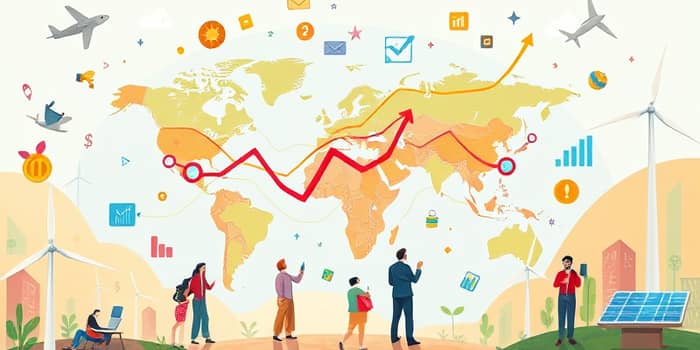
In an era marked by rapid change and geopolitical shifts, businesses and governments alike face the challenge of navigating an ever-evolving marketplace. From shifting trade patterns to emerging technologies, the global economy in 2025 demands agility, foresight, and a willingness to embrace new paradigms. Success will hinge on understanding key trends, anticipating disruptions, and crafting strategies that embed flexibility and innovation at their core.
As markets continue to react to policy decisions, climate imperatives, and technological breakthroughs, leaders must cultivate a mindset of continuous learning. Only by staying informed and proactive can organizations transform uncertainty into opportunity, building resilience and driving sustainable growth.
Global Economic Trends
The International Monetary Fund projects 3.0% global growth for 2025, with a modest uptick to 3.1% in 2026. Yet some forecasters caution that barriers to commerce, policy uncertainty, and political tensions could trim that figure to as low as 2.3%. Inflation, though generally easing worldwide, may remain stubbornly above target in the United States, even as the European Union anticipates reaching the European Central Bank’s 2% goal by mid-2025.
Trade-related distortions are gradually unwinding after a period of heightened tariffs, but the legacy of protectionist measures continues to reshape supply chains. Companies are diversifying trade networks and partnerships, seeking stability through geographical diversification and resilient sourcing strategies.
Regional Economic Insights
Across North America, American exceptionalism faces new tests as fiscal debates, bond market volatility, and tighter immigration policies weigh on growth prospects. Tariffs on key imports have altered the competitive landscape, forcing manufacturers to reevaluate production locations and input sourcing, while monetary policy decisions will be critical in steering inflation back toward target levels.
In Europe, GDP expansion is projected at 1.1% for 2025 and 1.5% for 2026, reflecting a gradual recovery from pandemic aftershocks and energy market disruptions. Despite the downward trend in inflation—set to average 1.7% in 2026—export growth remains muted. Companies in the eurozone must contend with heightened global competition and the lingering effects of supply chain bottlenecks.
Asia presents a complex mosaic. China’s growth deceleration underscores the need for a robust fiscal response to sustain domestic demand. Meanwhile, India’s optimism is tied to global trade dynamics and its burgeoning technology sector. The integration of artificial intelligence in semiconductor production is set to benefit Taiwan, South Korea, and Malaysia, reinforcing the region’s strategic importance in high-tech value chains.
Key Themes Driving Market Evolution
Several overarching forces are reshaping the economic terrain:
- Geoeconomic fragmentation and trade barriers have spurred countries to rethink alliances and pursue regional trade agreements.
- Accelerated digitization and remote work trends continue to transform industries, enabling new business models and workforce structures.
- Sustainable energy transition efforts are gaining momentum as policymakers balance growth objectives with environmental commitments.
- Artificial intelligence, from machine learning to generative models, is driving productivity gains but also raising questions about inequality and labor market displacement.
The convergence of these themes demands an integrated approach. Stakeholders must assess risks holistically, aligning financial, operational, and environmental strategies to navigate volatility and capitalize on emerging opportunities.
Strategies for Adaptation and Resilience
Adapting to this dynamic economic landscape requires proactive planning and bold execution. Organizations should consider the following strategies:
- Diversify supply chains to reduce dependency on any single region and build buffers against geopolitical shocks.
- Invest in digital infrastructure and upskilling programs to harness the full potential of AI, automation, and remote collaboration.
- Embrace sustainable practices, such as green financing and carbon reduction initiatives, to align with evolving regulatory landscapes and consumer preferences.
- Foster a culture that values experimentation and rapid iteration, enabling teams to test ideas, learn from failures, and scale successful innovations.
- Establish robust risk-management frameworks that integrate scenario planning, stress testing, and real-time data analytics for agile decision-making.
Ultimately, success in 2025 and beyond will hinge on an organization’s ability to iterate swiftly and pivot as conditions evolve. Leaders must champion a vision that balances short-term performance with long-term sustainability, ensuring that every strategic move reinforces the company’s core values and objectives.
Conclusion
The global economy is at a crossroads, shaped by the interplay of policy shifts, technological breakthroughs, and environmental imperatives. While uncertainty is inherent to this journey, it also brings the promise of innovation and progress for those prepared to adapt.
By understanding key trends—from global economic interconnectedness and volatility to the rise of AI—and implementing strategies that prioritize flexibility, sustainability, and learning, businesses and policymakers can not only weather the storm but emerge stronger. The path forward demands courage, collaboration, and a steadfast commitment to turning challenges into catalysts for growth.
As you chart your course in this dynamic economic landscape, remember that resilience is not just about survival—it’s about thriving in the face of change and shaping the future of markets for generations to come.
References
- https://www.oxfordeconomics.com/key-themes-2025/
- https://www.imf.org/en/Publications/WEO/Issues/2025/07/29/world-economic-outlook-update-july-2025
- https://economy-finance.ec.europa.eu/economic-forecast-and-surveys/economic-forecasts/spring-2025-economic-forecast-moderate-growth-amid-global-economic-uncertainty_en
- https://www.weforum.org/stories/2025/08/inflection-points-7-global-shifts-defining-2025-so-far-in-charts/
- https://www.accaglobal.com/gb/en/professional-insights/global-economics/global-outlook2025.html
- https://www.mckinsey.com/capabilities/strategy-and-corporate-finance/our-insights/economic-conditions-outlook
- https://www.worldbank.org/en/publication/global-economic-prospects
- https://www.oecd.org/en/about/news/press-releases/2025/09/global-economic-outlook-weakens-as-policy-uncertainty-weighs-on-demand.html
- https://www.edc.ca/en/article/global-economic-trends.html
- https://www.crescendoworldwide.com/trending/navigating-the-global-economic-landscape-unveiling-trends-and-projections-for-future-success