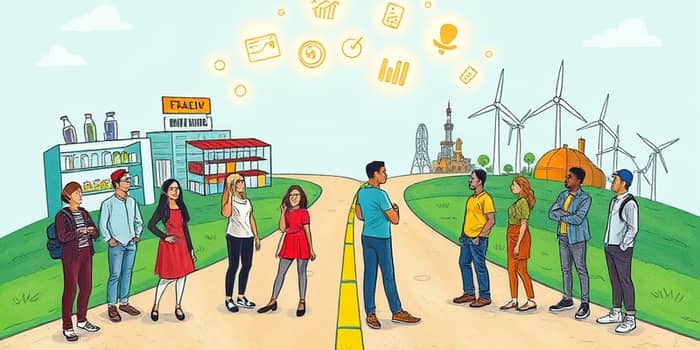
In an era of rapid transformation, every purchase becomes a vote and every decision a directional signal. From the groceries we select to the energy plans we embrace, consumers hold unprecedented power to redefine markets and compel industries to evolve. This article explores how individual choices converge at critical junctures, shaping the future of sectors ranging from retail and manufacturing to energy and beauty.
At this pivotal moment, the convergence of economic upheaval, technological leaps, social shifts, and environmental urgency demands that businesses listen closely. Consumers are no longer passive recipients; they are architects of change, staking claims on sustainability, personalization, and innovation.
Consumers as Catalysts for Change
Today’s customers navigate what many analysts call a once-in-a-century economic transition, marked by volatile markets, widening inequality, and the accelerating impacts of climate change. Their evolving expectations force companies to adopt bold strategies or face obsolescence. Trust, transparency, and responsibility have moved from optional values to mandatory pillars.
Six primary forces drive the strategic planning process for businesses aiming to respond effectively:
- Changing consumer demographics: More diverse tastes, values, and spending behaviors demand tailored offerings.
- Evolving society and culture: Traditional anchors give way to fluid identities and digital communities.
- Exponential xTech advancements: Breakthroughs in biotech, infotech, and materials science open new frontiers.
- Radical industry upheaval: Accelerating innovation cycles disrupt established value chains.
- Extreme climate change pressures: Sustainability becomes a baseline requirement, not a differentiator.
- Shifting economics, policy, and power: Global uncertainties call for agile management and adaptive governance.
Beyond these macro drivers, three prominent trends shape purchasing patterns across categories. First, the shift from mass to micro markets rewards hyper-targeted products. Second, digital and hybrid experiences blur the lines between online and offline. Third, data privacy, equity, and sustainability emerge as non-negotiable demands—responsibility as a requisite for trust.
Case Studies: Industry Reconfigurations
Across sectors, the choices consumers make today are redrawing competitive boundaries. Consider the following snapshot:
These snapshots reveal that adaptive companies are reaping rewards from data-driven adaptation and consumer insights. Firms that integrate analytics to forecast demand, personalize engagement, and optimize supply chains sustain growth, while traditional players face market share erosion.
Strategies for Businesses and Policymakers
To harness the transformative potential of consumer choices, organizations must adopt multi-faceted approaches that extend beyond shareholder returns:
- Embed sustainability metrics into every decision, measuring impact on environment and society.
- Leverage predictive analytics and AI to anticipate trends and tailor offerings in real time.
- Foster transparent ecosystems, sharing data and aligning incentives across partners.
- Design governance models that encourage experimentation and rapid iteration.
- Empower employees with digital tools and continuous learning paths to manage complexity.
- Engage consumers as collaborators, inviting feedback loops and co-creation opportunities.
By aligning with consumer values and deploying personalized marketing and sustainability gains, companies build resilience and unlock new revenue streams. Policymakers, too, play a critical role: crafting incentives, updating regulations, and ensuring equitable access to innovation.
Looking Ahead: The Future of Consumer Choices
As Gen Z emerges as the largest purchasing cohort, their digital fluency and social consciousness will intensify pressure on industries to elevate values and operational agility. The gig economy will reshape labor markets, influencing manufacturing and service capabilities. Climate imperatives will accelerate the energy transition, making retail choice in green power standard rather than exceptional.
The road ahead is neither linear nor predetermined. Each consumer stands at a crossroads, where the pathways they select determine which business models flourish and which fade. In this landscape, algorithms and automation for demand responsiveness will coexist with human-centric design, sparking collaborations that blur traditional sector boundaries.
Ultimately, industries that recognize the power embedded in every choice and respond with bold, inclusive, and adaptive strategies will emerge as the architects of tomorrow’s economy. Consumers, wielding their agency at every checkout and subscription, will continue to be the compass guiding this evolution.
References
- https://www.deloitte.com/us/en/industries/consumer/about/future-of-consumer-industry.html
- https://www.deloitte.com/global/en/industries/consumer/research/future-of-consumer-industry.html
- https://investornews.com/market-opinion/the-u-s-at-a-strategic-crossroads-with-china-and-the-industrial-policy-lifeline-and-relationships-that-could-save-us/
- https://www.oneupweb.com/blog/consumer-behavior-marketing/
- https://omdia.tech.informa.com/om123035/manufacturing-at-the-crossroads-how-the-us-election-could-shape-the-future-of-the-manufacturing-industry
- https://www.pwc.com/us/en/industries/consumer-markets/library/consumer-markets-trends.html
- https://www.rbccm.com/en/insights/2025/11/ai-credit-and-the-consumer-crossroads-market-signals-for-2026
- https://nielseniq.com/global/en/info/consumer-behavior/
- https://www.ogilvy.com/ideas/gen-zs-economic-crossroads-generational-opportunity-brands
- https://www.clootrack.com/knowledge/customer-behavior-analytics/major-factors-influencing-consumer-behavior
- https://nielseniq.com/global/en/industries/public-sector/
- https://online.longwood.edu/business/mba/marketing/how-consumer-decisions-are-researched/
- https://www.mckinsey.com/industries/consumer-packaged-goods/our-insights/a-close-look-at-the-global-beauty-industry-in-2025